
Friday, June 25, 2010
The Science of Science Fiction: Microbe Nation
I was reading the July issue of Scientific American earlier when I came across this article on microscopic giants. Microbes make up at least half of the oceans' total biomass; it may even be as high as ninety percent. A single liter (about one-fifth of a gallon) of ocean water can contain over a billion microbes--I guess this is the real reason you're not supposed to drink seawater! But the point I found most inspiring from a science fiction perspective was the discovery of a mat of microbes off the coast of South America. The mat is estimated to be the size of Greece. What could you do with so many microbes? Could you create a mat solid enough to indeed form a new nation? How about a floating farm or a natural sponge to digest spilled oil? What if that mat was really a single enormous feature? What ideas can you come up with?


Thursday, June 24, 2010
A Writer's Vacation
I found out today I still have five full weeks of vacation time this year at work. (I carried over two weeks of vacation time from last year, and I've only taken one vacation day plus one floating holiday this year.) I think I better start using some of it! It's been a long time since my husband and I took a date day (we both take off work, drop Alex off at daycare, and go off on our own), so we'll have to do that. I'd also love to go somewhere--if we can figure out how to make that work with a three-year-old. Knowing me, I'll probably use some time just to clean the house. It would be nice to have some time to write and edit too.
What do you do on vacation? Do you still write? Or do you go somewhere and do things you can write about later?
What do you do on vacation? Do you still write? Or do you go somewhere and do things you can write about later?
Wednesday, June 23, 2010
Sympathy for Your Characters
Plot to Punctuation (or Show Some Character!, which is the name of this blog on my reader) had a great post yesterday about how to create sympathetic characters. Some of the techniques listed there include creating a character who has a sense of humor and can laugh at him/herself, having them be kind to others, and having other characters admire them for their skills.
There's a section in Orson Scott Card's Writer Digest book Characters and Viewpoint in which he also discusses the traits that make us loathe and love particular characters. I was surprised that there wasn't much overlap between the two lists. Sure, having a good sense of humor might be part of having a good overall attitude, and Card discusses several aspects of the altruistic character. However, Card thinks physical attractiveness and cleverness can also make people love characters. What's interesting about those traits is that they're double-edged swords; for instance, some readers may resent characters who are too good-looking. (Card admits it's much harder to use physical attractiveness in books than in visual media, where you can see the actors/actresses.) As for cleverness, Card is careful to note that characters who come across as too intellectual or too pleased with their own intelligence can turn readers off.
I don't have an all-time favorite character; I'm so busy trying to keep up with my to-read pile that I don't have a chance to reread books. Sometimes when I'm following a series, I find I don't enjoy the later books as much as I did earlier ones. But I do like practical characters who can get things done, such as Alexia from the Soulless books and Mrs. Quent from The Magician and Mrs. Quent. Who are your favorite characters, and why do you like them?
P.S. If you don't already, I recommend following the Plot to Punctuation/Show Some Character! blog I linked to above. There's a lot of great posts there on characterization.
There's a section in Orson Scott Card's Writer Digest book Characters and Viewpoint in which he also discusses the traits that make us loathe and love particular characters. I was surprised that there wasn't much overlap between the two lists. Sure, having a good sense of humor might be part of having a good overall attitude, and Card discusses several aspects of the altruistic character. However, Card thinks physical attractiveness and cleverness can also make people love characters. What's interesting about those traits is that they're double-edged swords; for instance, some readers may resent characters who are too good-looking. (Card admits it's much harder to use physical attractiveness in books than in visual media, where you can see the actors/actresses.) As for cleverness, Card is careful to note that characters who come across as too intellectual or too pleased with their own intelligence can turn readers off.
I don't have an all-time favorite character; I'm so busy trying to keep up with my to-read pile that I don't have a chance to reread books. Sometimes when I'm following a series, I find I don't enjoy the later books as much as I did earlier ones. But I do like practical characters who can get things done, such as Alexia from the Soulless books and Mrs. Quent from The Magician and Mrs. Quent. Who are your favorite characters, and why do you like them?
P.S. If you don't already, I recommend following the Plot to Punctuation/Show Some Character! blog I linked to above. There's a lot of great posts there on characterization.
Tuesday, June 22, 2010
Monday, June 21, 2010
Illinois Railway Museum
We took Alex to the Illinois Railway Museum yesterday. He got to ride on a train, get even more Thomas cars, and see barns and barns full of trains. Of course, now he thinks they're all his and wants to drive one of them. I got to do some research for a train ride my characters take in Across Two Universes. Here are a few photos:


Sunday, June 20, 2010
Alex and the Paci Fairy
I thought I'd share a few child-related anecdotes and photos before returning to writing topics. I should warn you that this post is not for the faint of heart, though.
Alex starting using a pacifier very early--and kept on using it. He doesn't use it at daycare, and while it's mostly at bedtime, sometimes he uses it around the house. Although he can speak fairly well, and his dentist wasn't too concerned, we didn't want this dragging on forever. So when he lost some of his pacis, we didn't replace them. Soon he was down to one well-chewed paci. It had so many holes in it I doubt he could really use it; he just clung to it for security.
Yesterday, after naptime, Alex brought his paci with him while he used the toilet. Well, he flushed, then dropped his paci, and down it went. Even if I could've caught it, it certainly wasn't usable anymore! Alex was extremely upset, crying, yelling, and kept demanding his paci back "right now." I comforted him, but I told him it wasn't coming back. To distract him, I tried a technique I'd read about: I told him the paci fairy took it but would give him a toy in exchange. Fortunately, I had a bunch of toys one of my coworkers brought back from Japan, and we had fun opening them and playing with them for a while.
The paci fairy had one more gift for Alex, though. When he went to bed, he found one of the Thomas the Tank Engine trains waiting for him. (We bought a secondhand collection, which we intend to give him gradually.) He accepted it as a new comfort object and slept with it. I had prepared myself for a problematic bedtime, but he went down easily.
Looking back now, I wonder if we could have taken the paci from Alex sooner. But I think there are some advantages to the way it did work out. He knows it's gone, he can't blame us for taking it from him, and he got a chance to "get the mourning" out of his system, so to speak. Ah, our son is growing up.
Alex starting using a pacifier very early--and kept on using it. He doesn't use it at daycare, and while it's mostly at bedtime, sometimes he uses it around the house. Although he can speak fairly well, and his dentist wasn't too concerned, we didn't want this dragging on forever. So when he lost some of his pacis, we didn't replace them. Soon he was down to one well-chewed paci. It had so many holes in it I doubt he could really use it; he just clung to it for security.
Yesterday, after naptime, Alex brought his paci with him while he used the toilet. Well, he flushed, then dropped his paci, and down it went. Even if I could've caught it, it certainly wasn't usable anymore! Alex was extremely upset, crying, yelling, and kept demanding his paci back "right now." I comforted him, but I told him it wasn't coming back. To distract him, I tried a technique I'd read about: I told him the paci fairy took it but would give him a toy in exchange. Fortunately, I had a bunch of toys one of my coworkers brought back from Japan, and we had fun opening them and playing with them for a while.
The paci fairy had one more gift for Alex, though. When he went to bed, he found one of the Thomas the Tank Engine trains waiting for him. (We bought a secondhand collection, which we intend to give him gradually.) He accepted it as a new comfort object and slept with it. I had prepared myself for a problematic bedtime, but he went down easily.
Looking back now, I wonder if we could have taken the paci from Alex sooner. But I think there are some advantages to the way it did work out. He knows it's gone, he can't blame us for taking it from him, and he got a chance to "get the mourning" out of his system, so to speak. Ah, our son is growing up.
Friday, June 18, 2010
Bad Boys vs. Bad Guys
What makes a bad boy--the kind so often cast as the romantic lead--different from a bad guy--the kind we love to hate? Check out this post from the Supernatural Underground for insights (apparently, first impressions are key). There's also a book giveaway if you leave a comment, but you'll have to hurry, as the contest ends in a couple of hours!
Thursday, June 17, 2010
Back on the Blog Chain: Where Do You Get Your Ideas?
I'm part of a blog chain with a group of other writers in various genres. (You can find links to the other members in the sidebar.) About twice a month, we discuss different writing topics. This time, Shaun, whose novel The Deathday Letter was just published this week, asked us this question:
From where do you get your inspiration for stories? Give me the oddest, coolest, things that have inspired you.
Kate preceded me in the chain, and Eric comes after me.
I actually discussed this topic on my website ages ago, but I don't think it's enough for the blog chain to just provide a link. Besides, ideas are everywhere. I get them from my daily experiences, from people I meet online, from science articles, and from other books. This is good, as I feel one idea isn't always enough to create a story; you need two ideas to create a story with a unique angle. As an example, my short story "A Reptile at the Reunion" was inspired by an invitation to my graduate school reunion and a magazine's challenge to write a story around the line, "Say, aren't you dead?" (In the first draft of the story, my main character was presumed dead by her classmates, but in the final version, she's just been on another planet for a long time.)
I've also received inspiration from the Beatles, my favorite musical group. Their four-fold synergy inspired me to create a quartet of female magicians who must work together to save their country from a storm that mixes up the seasons. I also used to write Beatles fan fiction, and after reading a story about the Beatles in the Cavern (a club in Liverpool where they played before they became famous), I wanted to use the same setting too. As a science fiction writer, I wanted to give the story a SF twist, so I sent a descendant of John's back in time to clone him. That story, "Move Over Ms. L.," earned me an Honorable Mention in an international novella competition, but it also inspired me to then write a story about the clone. After many rewrites and removal of most of the Beatle references, I wound up with my current WIP, Across Two Universes.
That leads me to my final point: once I come up with characters and a story, I find that they inspire me to write more stories about them. What I think will be a short story may be the start of a saga. And while that may not be the oddest inspiration I've received so far, I still think it's pretty cool.
From where do you get your inspiration for stories? Give me the oddest, coolest, things that have inspired you.
Kate preceded me in the chain, and Eric comes after me.
I actually discussed this topic on my website ages ago, but I don't think it's enough for the blog chain to just provide a link. Besides, ideas are everywhere. I get them from my daily experiences, from people I meet online, from science articles, and from other books. This is good, as I feel one idea isn't always enough to create a story; you need two ideas to create a story with a unique angle. As an example, my short story "A Reptile at the Reunion" was inspired by an invitation to my graduate school reunion and a magazine's challenge to write a story around the line, "Say, aren't you dead?" (In the first draft of the story, my main character was presumed dead by her classmates, but in the final version, she's just been on another planet for a long time.)
I've also received inspiration from the Beatles, my favorite musical group. Their four-fold synergy inspired me to create a quartet of female magicians who must work together to save their country from a storm that mixes up the seasons. I also used to write Beatles fan fiction, and after reading a story about the Beatles in the Cavern (a club in Liverpool where they played before they became famous), I wanted to use the same setting too. As a science fiction writer, I wanted to give the story a SF twist, so I sent a descendant of John's back in time to clone him. That story, "Move Over Ms. L.," earned me an Honorable Mention in an international novella competition, but it also inspired me to then write a story about the clone. After many rewrites and removal of most of the Beatle references, I wound up with my current WIP, Across Two Universes.
That leads me to my final point: once I come up with characters and a story, I find that they inspire me to write more stories about them. What I think will be a short story may be the start of a saga. And while that may not be the oddest inspiration I've received so far, I still think it's pretty cool.
Wednesday, June 16, 2010
Description in Fiction
First, I'd like to say "hello" to my new followers. (I'm just one shy of 50 now!) I assume you found me through the blogfest. I haven't had a chance to read everyone's yet, but I hope to look at some more character interviews tonight. It was fun interviewing Anne and Clarice, and I learned something about them. I'll have to try that with some of my other characters.
I've taken a break from the story I'm writing about Anne and Clarice to reread Across Two Universes, as I feel it's sat long enough for me to look at it with fresh eyes. There are things I want to tweak here and there, but I don't feel I have to rewrite the whole darn thing, so I suppose that's progress. We'll see what the next set of readers think. One thing I have noticed, however, is that it could use more description; in fact, it seems more vivid to me in the places there is description. I never feel comfortable including description, so I have to go back over a rough draft and weave it in. Hopefully I can do this here without increasing the word count too much.
How do you feel about description when you're reading a book? I don't like huge tracts of it, but it does help bring the world to life, especially if you appeal to several senses. It seems that some of the subgenres I read, like paranormals or urban fantasy, tend to be sparse on describing the setting and focus more on action. When there is description, it's most likely to be involving a character. Have you noticed any other trends in description?
I've taken a break from the story I'm writing about Anne and Clarice to reread Across Two Universes, as I feel it's sat long enough for me to look at it with fresh eyes. There are things I want to tweak here and there, but I don't feel I have to rewrite the whole darn thing, so I suppose that's progress. We'll see what the next set of readers think. One thing I have noticed, however, is that it could use more description; in fact, it seems more vivid to me in the places there is description. I never feel comfortable including description, so I have to go back over a rough draft and weave it in. Hopefully I can do this here without increasing the word count too much.
How do you feel about description when you're reading a book? I don't like huge tracts of it, but it does help bring the world to life, especially if you appeal to several senses. It seems that some of the subgenres I read, like paranormals or urban fantasy, tend to be sparse on describing the setting and focus more on action. When there is description, it's most likely to be involving a character. Have you noticed any other trends in description?
Tuesday, June 15, 2010
Character Interview Blogfest: Anne and Clarice
People on Facebook voted for an interview with my shapeshifting sisters, so Paul and Scott will have to wait to give their interviews. As I mentioned before, this blogfest is being hosted by Echoes of a Wayward Mind. Check the sidebar over there to visit the other sites participating in this character interview. Please note that I've "known" Anne and Clarice for a much shorter time than Paul and Scott; I haven't even settled on the sisters' family name. Some things may change as I learn more about them.
Setting: Anne and Clarice sit at opposite ends of a long couch. Anne, in her mid-late thirties, is still dressed for her day job as a paralegal, in a tan cardigan over a white blouse and dark brown skirt. Her short, dark brown hair is smoothed away from her face, and her pearl earrings are barely visible. Her glass of white wine, still more than half full, sits on the coffee table. Clarice, who appears to be in her mid-twenties, slouches against the couch. She's dressed for a fun night on the town in a turquoise halter top, white capris, and gold wedges. Her highlighted hair is tousled, and bangles in various colors chime softly whenever she raises her wine glass.
Sandra: So, Anne, Clarice, tell us a little bit about yourselves. Both of you can change into birds at will, but they're different types of birds, right?
Anne (nods): As different as day and night.
Clarice: That's her idea of a joke.
Anne: Seriously, I'm an owl, and Clarice is a crow.
Sandra: Did you choose your shapes?
Anne: No, there's a ceremony you go through when you're of age where you handle different animal skins. The one that bonds to you is the animal you can become.
Clarice: They say the animal matches your personality--
Anne: Most of the time. (raises eyebrow at her sister) Clarice sure talks as much as a crow, but you'd think she'd show more common sense.
Clarice (sticks out pierced tongue) Crows are some of the smartest birds, even smarter than owls. They can count up to three.
Anne (smiles sweetly): That's not very impressive for a human, dear.
Sandra (flips quickly through notebook for a question to change the subject): So, what are your goals?
Clarice: Meet a cute boy -- or boys -- and (glances sideways at her sister) have some fun.
Sandra: What about your long-term goals?
Clarice: What about them?
Anne: That's the problem, you don't have any.
Clarice: Well, I don't want to the lead the Council [the governing body of shapeshifters]! They're worthless!
Anne (leans forward): See, if I was on the Council, maybe I could get them to do something for us. We need more safe places for our animal forms, and we need to find more potential shapeshifters before we die out. We can't bite other people like werewolves, after all.
Sandra: Are werewolves a problem for shapeshifters?
Anne: Yes.
Clarice (speaking at the same time): No.
(the sisters glare at each other)
Sandra: Is it just me, or are you two your own worst enemies?
Anne (sighs): Clarice just likes getting her own way. She's the baby of the family, and Mom and Dad spoiled her all the time.
Clarice: Well, you make up for it by mothering me all the time like I'm still six.
Anne: If it weren't for me prodding you, you wouldn't have finished college so you could pay for a whole new wardrobe every season. You do pay off your credit card on time, don't you, sis?
Clarice (flushes): None of your business!
Anne: And if you'd listened to me, you wouldn't have gotten tangled up with that werewolf pack. Shifters and werewolves don't mix.
Clarice (crosses arms): I still say a shifter werewolf should have the best of both worlds.
Anne: Except it didn't work, did it? Do you want to tell everyone what happened when you let the werewolf leader change you?
Sandra: Let's not provide any spoilers before the story's finished, OK? Anne, Clarice, any final thoughts?
(They stare at each other for a long moment, their expressions finally softening.)
Anne: You don't have to be birds of a feather--
Clarice: To flock together.
(They rise from the couch and strip off their clothes. Before you can see their naked bodies, they shift into their bird forms and fly away).
Setting: Anne and Clarice sit at opposite ends of a long couch. Anne, in her mid-late thirties, is still dressed for her day job as a paralegal, in a tan cardigan over a white blouse and dark brown skirt. Her short, dark brown hair is smoothed away from her face, and her pearl earrings are barely visible. Her glass of white wine, still more than half full, sits on the coffee table. Clarice, who appears to be in her mid-twenties, slouches against the couch. She's dressed for a fun night on the town in a turquoise halter top, white capris, and gold wedges. Her highlighted hair is tousled, and bangles in various colors chime softly whenever she raises her wine glass.
Sandra: So, Anne, Clarice, tell us a little bit about yourselves. Both of you can change into birds at will, but they're different types of birds, right?
Anne (nods): As different as day and night.
Clarice: That's her idea of a joke.
Anne: Seriously, I'm an owl, and Clarice is a crow.
Sandra: Did you choose your shapes?
Anne: No, there's a ceremony you go through when you're of age where you handle different animal skins. The one that bonds to you is the animal you can become.
Clarice: They say the animal matches your personality--
Anne: Most of the time. (raises eyebrow at her sister) Clarice sure talks as much as a crow, but you'd think she'd show more common sense.
Clarice (sticks out pierced tongue) Crows are some of the smartest birds, even smarter than owls. They can count up to three.
Anne (smiles sweetly): That's not very impressive for a human, dear.
Sandra (flips quickly through notebook for a question to change the subject): So, what are your goals?
Clarice: Meet a cute boy -- or boys -- and (glances sideways at her sister) have some fun.
Sandra: What about your long-term goals?
Clarice: What about them?
Anne: That's the problem, you don't have any.
Clarice: Well, I don't want to the lead the Council [the governing body of shapeshifters]! They're worthless!
Anne (leans forward): See, if I was on the Council, maybe I could get them to do something for us. We need more safe places for our animal forms, and we need to find more potential shapeshifters before we die out. We can't bite other people like werewolves, after all.
Sandra: Are werewolves a problem for shapeshifters?
Anne: Yes.
Clarice (speaking at the same time): No.
(the sisters glare at each other)
Sandra: Is it just me, or are you two your own worst enemies?
Anne (sighs): Clarice just likes getting her own way. She's the baby of the family, and Mom and Dad spoiled her all the time.
Clarice: Well, you make up for it by mothering me all the time like I'm still six.
Anne: If it weren't for me prodding you, you wouldn't have finished college so you could pay for a whole new wardrobe every season. You do pay off your credit card on time, don't you, sis?
Clarice (flushes): None of your business!
Anne: And if you'd listened to me, you wouldn't have gotten tangled up with that werewolf pack. Shifters and werewolves don't mix.
Clarice (crosses arms): I still say a shifter werewolf should have the best of both worlds.
Anne: Except it didn't work, did it? Do you want to tell everyone what happened when you let the werewolf leader change you?
Sandra: Let's not provide any spoilers before the story's finished, OK? Anne, Clarice, any final thoughts?
(They stare at each other for a long moment, their expressions finally softening.)
Anne: You don't have to be birds of a feather--
Clarice: To flock together.
(They rise from the couch and strip off their clothes. Before you can see their naked bodies, they shift into their bird forms and fly away).
Monday, June 14, 2010
Character Interview Blogfest
I just found out (and signed up for) this character interview blogfest being hosted by Echoes of a Wayward Mind. It's tomorrow, so if you're interested, hurry over to the link and sign up. So there will be no Ten-Word Tuesday this week.
Since I'll write up the character interview tonight, I thought it would be interesting to see if my readers are interested in a particular character. I know I mention Paul Harrison, the protagonist of Across Two Universes, quite often here; do you want me to interview him? How about one of the secondary characters from that novel, such as Scott, Paul's best friend? Or would you like me to do a dual interview with Anne and Clarice, my shapeshifting heroines from my NaNoWriMo novel? Please vote in the comment section before 5:00 p.m. CDT. Thanks!
Since I'll write up the character interview tonight, I thought it would be interesting to see if my readers are interested in a particular character. I know I mention Paul Harrison, the protagonist of Across Two Universes, quite often here; do you want me to interview him? How about one of the secondary characters from that novel, such as Scott, Paul's best friend? Or would you like me to do a dual interview with Anne and Clarice, my shapeshifting heroines from my NaNoWriMo novel? Please vote in the comment section before 5:00 p.m. CDT. Thanks!
Sunday, June 13, 2010
Lawnmower Woman
This morning, as Eugene was mowing the lawn, Alex wanted to follow him outside. That meant I had to go along to supervise him. We bought him a tricycle yesterday, so naturally he wanted to play with it and go to the park. (He's still getting used to pedaling instead of pushing himself along.) Unfortunately, Alex has recently developed a strong fear of bugs, so he got panicked and insisted on going back to the house. Then only Daddy would do to comfort him, but Eugene hadn't finished. So I did the only thing a mother could do: I offered to finish mowing the lawn so Eugene could take care of Alex.
I've only mowed a lawn once before, when I was a teenager. The yard was steeply sloped, and my foot slipped, nearly going under the lawnmower. I wasn't hurt, but I wasn't in a hurry to try mowing the lawn again. Eugene had to show me how to operate the lawnmower before bringing Alex inside. It was a bit tricky to steer at first, especially around objects like the trees and the swingset. I also left a swath by the side of the house undone after turning off the lawnmower, and although I tried, I couldn't pull the cord hard enough to restart the mower. Eugene came out later to finish up and do the edges, but he appreciated the assistance.
I suppose if I were to apply this incident to writing, I would say sometimes it's worth trying something you're not comfortable with and to be careful not to let your project get away from you. Since it's late, the only witty thing I can come up with is that the grass is always greener on the other side of keyboard.
I've only mowed a lawn once before, when I was a teenager. The yard was steeply sloped, and my foot slipped, nearly going under the lawnmower. I wasn't hurt, but I wasn't in a hurry to try mowing the lawn again. Eugene had to show me how to operate the lawnmower before bringing Alex inside. It was a bit tricky to steer at first, especially around objects like the trees and the swingset. I also left a swath by the side of the house undone after turning off the lawnmower, and although I tried, I couldn't pull the cord hard enough to restart the mower. Eugene came out later to finish up and do the edges, but he appreciated the assistance.
I suppose if I were to apply this incident to writing, I would say sometimes it's worth trying something you're not comfortable with and to be careful not to let your project get away from you. Since it's late, the only witty thing I can come up with is that the grass is always greener on the other side of keyboard.
Friday, June 11, 2010
Discussion: Stories/Characters We Never See
Yes, I know it's Friday, the start of a summer weekend, and I should post something light and fluffy. But Alex has had a hard time transitioning full-time into the preschool room at daycare. He's been very clingy at dropoff, and he's been waking up at 2 and 3 a.m. Unlike Alex and Eugene, I have a hard time falling back asleep once I've been woken up, so I'm managing on less than four hours of sleep on top of my normal sleep deprivation. All this is my roundabout way of justifying why I want you to discuss this topic with me; I can't manage it on my own. ;)
Anyway, we all know there are certain tropes that are a convention in fiction: the good guys always win, the hero always gets the girl, Dorothy will always prefer Kansas over Oz. (Of course, there are exceptions to these rules, but I'm generalizing.) Do you prefer stories that match these conventions or ones that defy them? For me, I'm more inspired by the stories that don't get told, such as ones where the main character, after visiting a new world, decides to stay instead of returning home. (I guess Avatar would count as this type of story, wouldn't it?) What stories can you think of that don't abide by the normal tropes of fiction? What types of characters are underrepresented in fiction who deserve to have stories told about them?
As for light and fluffy, perhaps I should make frozen citrus bars.
Have a good weekend, everyone!
Anyway, we all know there are certain tropes that are a convention in fiction: the good guys always win, the hero always gets the girl, Dorothy will always prefer Kansas over Oz. (Of course, there are exceptions to these rules, but I'm generalizing.) Do you prefer stories that match these conventions or ones that defy them? For me, I'm more inspired by the stories that don't get told, such as ones where the main character, after visiting a new world, decides to stay instead of returning home. (I guess Avatar would count as this type of story, wouldn't it?) What stories can you think of that don't abide by the normal tropes of fiction? What types of characters are underrepresented in fiction who deserve to have stories told about them?
As for light and fluffy, perhaps I should make frozen citrus bars.
Have a good weekend, everyone!
Wednesday, June 09, 2010
Is the Pen Really Mightier Than This Sword?
I mentioned in my WisCon report that I'd won a sword from a book dealer. I didn't have any pictures at that time, but I do now. Here are a couple of them:


I think it would be cool sometime to rent a costume and take more pictures of me with the sword. Perhaps once Eugene gets his portrait equipment set up in the basement we can do that.


I think it would be cool sometime to rent a costume and take more pictures of me with the sword. Perhaps once Eugene gets his portrait equipment set up in the basement we can do that.
Tuesday, June 08, 2010
Monday, June 07, 2010
Alex's Third Birthday Party
I wanted to post this last night, but Blogger was down.
For Alex's last two birthdays, the parties were for our family and friends. This year, we decided he was ready for a kid's party. We'd been to one last year that was held at a kid's gym, so I found one in our area and booked a party. They took care of most of the arrangements: sending out invitations; ordering the pizza; and supplying the cups, plates, and other necessary items. The only things I had to do were assemble the guest list and goodie bags, order the cake, and bring in snacks and extra food for the adults. Some of the guests weren't able to make it, but we had eight other children besides Alex. Most of them were from his daycare/playgroup; some of them were kids of our friends.
Alex can be a bit clingy in new situations, so I was worried he might take some time to warm up at his party. Even though he didn't nap very well, he did better than I thought he would. (It might have helped that I told him about his party in advance and that he saw the cake and goodie bags.) He was a bit hesitant when we first arrived, but once we brought him into the gym, he took off, running, laughing, and having a good time. Most of the other kids did the same.
The kids got to play in the gym for an hour. It was set up for gymnastics with kid-size equipment: balance beams, uneven bars, and plenty of mats. Alex particularly enjoyed crawling through a donut-shaped mat:

Later on, the coaches plugged the donut and placed it between two wedges. The kids got to ride on top of the donut and, with the help of the coach, tumble over and land on their backs. Alex and a couple of the kids liked it so much they did it several times.

In addition, the coaches blew bubbles, brought out balls, and played with a parachute. Alex found a foam sword and chased his "girlfriend" around with it. Toward the end of the hour, they brought out an AirTrack, an inflatable bouncy thing that the kids (and some of the mothers, including me) could jump on. Alex's girlfriend got her revenge by wrestling Alex and pinning him down!
After the play hour was over, the kids sat down at a square table for pizza, juice boxes, and cake. This was the first year we lit candles for Alex's cake (I didn't feel it was safe before). He tried blowing them out, but I wound up helping him. He was more interested in the plastic cars decorating the cake than the cake itself; he took a couple bites of frosting, then played with the cars. We gave out goodie bags and balloons (supplied by the gym), then took Alex and all of his presents home. I think the kids all had a great time; perhaps we'll hold his party here next year too.
For Alex's last two birthdays, the parties were for our family and friends. This year, we decided he was ready for a kid's party. We'd been to one last year that was held at a kid's gym, so I found one in our area and booked a party. They took care of most of the arrangements: sending out invitations; ordering the pizza; and supplying the cups, plates, and other necessary items. The only things I had to do were assemble the guest list and goodie bags, order the cake, and bring in snacks and extra food for the adults. Some of the guests weren't able to make it, but we had eight other children besides Alex. Most of them were from his daycare/playgroup; some of them were kids of our friends.
Alex can be a bit clingy in new situations, so I was worried he might take some time to warm up at his party. Even though he didn't nap very well, he did better than I thought he would. (It might have helped that I told him about his party in advance and that he saw the cake and goodie bags.) He was a bit hesitant when we first arrived, but once we brought him into the gym, he took off, running, laughing, and having a good time. Most of the other kids did the same.
The kids got to play in the gym for an hour. It was set up for gymnastics with kid-size equipment: balance beams, uneven bars, and plenty of mats. Alex particularly enjoyed crawling through a donut-shaped mat:

Later on, the coaches plugged the donut and placed it between two wedges. The kids got to ride on top of the donut and, with the help of the coach, tumble over and land on their backs. Alex and a couple of the kids liked it so much they did it several times.

In addition, the coaches blew bubbles, brought out balls, and played with a parachute. Alex found a foam sword and chased his "girlfriend" around with it. Toward the end of the hour, they brought out an AirTrack, an inflatable bouncy thing that the kids (and some of the mothers, including me) could jump on. Alex's girlfriend got her revenge by wrestling Alex and pinning him down!
After the play hour was over, the kids sat down at a square table for pizza, juice boxes, and cake. This was the first year we lit candles for Alex's cake (I didn't feel it was safe before). He tried blowing them out, but I wound up helping him. He was more interested in the plastic cars decorating the cake than the cake itself; he took a couple bites of frosting, then played with the cars. We gave out goodie bags and balloons (supplied by the gym), then took Alex and all of his presents home. I think the kids all had a great time; perhaps we'll hold his party here next year too.
Saturday, June 05, 2010
If a Picture's Worth a Thousand Words...
Then my husband regularly outwrites me. ;) He's an amateur photographer, and he started a blog yesterday devoted to his photography. You can find it here. He hasn't posted anything yet, but he plans to upload a photo at least once a week. Join me in harassing reminding him to keep up with his blog!
Friday, June 04, 2010
Website or Blog?
I was going to upload my panel notes from WisCon 34 to my website last night, but it's been so long since I've done anything to my website that I've forgotten how to embed internal page links. I'll have to try it again tonight. But that made me wonder this morning as I was driving to work what's more effective for authors: websites or blogs. To me, websites are places I go to for static information, such as if I want to check the author's list of works or learn more about him/her. Blogs are easier to update and are more interactive. I personally visit more blogs on a daily basis than I do author websites, which I only check out if I have a specific question. And while I'm not planning to ditch my website, I do like that Blogger now allows me to put up separate pages on my blog, which I use for my bio and list of sales. (At some point, I intend to move my links from the sidebar onto their own page.) I'm even thinking of reviving my LiveJournal blog, since it seems that a fair amount of people in the SF community use that instead of Blogger. Maybe if I can sync up my blogs I can actually maintain two at once. So I'd like to hear your opinions: are you more interested in an author's website or blog? Does it make a difference to you if the author is published or not? (I go to more published authors' websites but read more unpublished writers' blogs.) Do you maintain a website, blog, or both?
Contest Annoucement
To make sure you're committed to writing (that's dedicated to it, not insane--although sometimes there's a fine line between the two *grin*), Christine Fonseca is running a "Go Big or Go Home!" contest on her blog. You can win both a $20 gift card from B&N and a ten-page critique from her. All you have to do is publicly commit to writing on her blog. You can find the full details here. Better hurry, the contest ends Sunday, June 6th!
Wednesday, June 02, 2010
The Science of Science Fiction--Thinking Big
Big animals, that is. If you want to create a world with huge land animals, you couldn't ask for better models than the dinosaurs. This Q&A from the New York Times lists some of the anatomical features that helped the dinosaurs succeed. (The article is based on another article from Biological Reviews.) They're listed below.
1. A very long neck to reach food
2. A small head that didn't put a lot of weight on the very long neck
(Side note: if you've been to the Field Museum in Chicago to see Sue the T. rex, you may have noticed that her head is displayed separately from the rest of her skeleton. Without the muscles and connective tissue, the skeleton can't support the weight of her skull.)
3. A digestive system that didn't require food to be chewed extensively (this apparently allowed the head to be small)
4. A highly dispersed respiratory system that made it easier to breathe and helped keep the dinosaurs cool.
So there you have it. I can't help but wonder if the environment also played a part. There is some evidence that there were increased levels of oxygen and carbon dioxide in the atmosphere, which would have allowed plants to grow faster. You would need a lot of plants to feed dinosaur-sized herbivores! But could you have huge, intelligent creatures with small heads? Perhaps if they had a decentralized nervous system, though to me, it seems unlikely that a "spread-out" brain could give rise to intelligence. But in science fiction, perhaps it can.
1. A very long neck to reach food
2. A small head that didn't put a lot of weight on the very long neck
(Side note: if you've been to the Field Museum in Chicago to see Sue the T. rex, you may have noticed that her head is displayed separately from the rest of her skeleton. Without the muscles and connective tissue, the skeleton can't support the weight of her skull.)
3. A digestive system that didn't require food to be chewed extensively (this apparently allowed the head to be small)
4. A highly dispersed respiratory system that made it easier to breathe and helped keep the dinosaurs cool.
So there you have it. I can't help but wonder if the environment also played a part. There is some evidence that there were increased levels of oxygen and carbon dioxide in the atmosphere, which would have allowed plants to grow faster. You would need a lot of plants to feed dinosaur-sized herbivores! But could you have huge, intelligent creatures with small heads? Perhaps if they had a decentralized nervous system, though to me, it seems unlikely that a "spread-out" brain could give rise to intelligence. But in science fiction, perhaps it can.
Tuesday, June 01, 2010
Monday, May 31, 2010
WisCon 34 Recap
Well, another WisCon has come and gone. As you can tell, I was so busy I didn't get any blogging done at the con. I'll try to recap the high points quickly.
We left Friday afternoon after picking Alex up directly from daycare. The drive wasn't too bad, though we stopped a couple of times for potty breaks. Alex refused to go in the bathroom at the reststop, so we took him to my parents' house, which was on the way. I'm pleased to report Alex is now using regular toilets as long as he has something to stand on. (If you're not a parent, trust me, this is a big deal. He's not completely toilet trained yet, but he's definitely ready for preschool.) We arrived at our hotel in the early evening. After dinner, I picked up my badge from the registration desk. Unfortunately, they had no record of Alex being registered for daycare, but they let him in anyway. That was a big relief.
We didn't bother bringing a separate bed or crib for Alex, as we knew from past experience he wouldn't use it in a strange place. We had a very rough night trying to get him to sleep in the same bed as us; I bounced from one bed to the other. I still got up to swim, though.
Saturday morning, we visited the Farmer's Market on Capitol Square. I saw only one stand with lilacs and no lily of the valley for sale; I wonder if that's because it was so warm or because Memorial Day weekend was so late. But I did snatch up some locally grown strawberries. Then I brought Alex to daycare. He was timid and very clingy at first, making me late for the morning panel. But he ate well at lunch and did better in the afternoon. I attended three panels on varying topics: infectious diseases, raising feminist boys, and witches. Eugene went around on his own to take pictures. He also stopped in one of my favorite Madison stores, the Soap Opera, and treated me to some scented shower gel. In the evening, we visited some college friends. They hosted a get-together dinner so we could see more friends too. That was very nice. I did go to some of the parties briefly when we got back, but I was too tired to stay long.
Sunday was Alex's third birthday. We'd brought along some presents, so he finally got to open them. After a quick breakfast in our room, I attended a panel on urban fantasy in Madison. (We did bring Alex to daycare, but he wouldn't let Eugene leave. But he didn't fuss when I brought him back for his nap.) I attended two more panels that afternoon, skipping the middle one to have gelato with Eugene, attend a tea, and chat with a friend. After panels, we took Alex to Ella's Deli for dinner. It boasts a carousel outside and lots of animated puppets/toys inside. Alex didn't know where to look! We treated him to a banana split, but he wasn't too interested in it. He did get to ride the carousel before we left.
Today as the con wound down, we took Alex to Vilas Zoo. He was more interested in the zoo train I bought than the animals. Then we drove down to visit my parents, where he got more presents and a cake. I also got to see my niece and her baby. We finally came home in the early evening.
I didn't network as much as I wanted to this time between being so tired and Alex's struggles with bedtime. Hopefully when he's a little older it'll be easier. (We're already registered for next year's WisCon.) I didn't buy too much this year, only two books and a blouse from Wintersilks. However, one of the books I bought entered me into a drawing for a sword. I had a good feeling about my chances, and sure enough, I won it! It's a black sword with a wickedly shaped blade. (The edge is dull, however; I couldn't risk bringing a real sword into the same house as a toddler!) I will post a picture of me wielding the sword at some point; I just have to decide what to wear. I don't have the body for a metal bikini, so don't even suggest it!
We left Friday afternoon after picking Alex up directly from daycare. The drive wasn't too bad, though we stopped a couple of times for potty breaks. Alex refused to go in the bathroom at the reststop, so we took him to my parents' house, which was on the way. I'm pleased to report Alex is now using regular toilets as long as he has something to stand on. (If you're not a parent, trust me, this is a big deal. He's not completely toilet trained yet, but he's definitely ready for preschool.) We arrived at our hotel in the early evening. After dinner, I picked up my badge from the registration desk. Unfortunately, they had no record of Alex being registered for daycare, but they let him in anyway. That was a big relief.
We didn't bother bringing a separate bed or crib for Alex, as we knew from past experience he wouldn't use it in a strange place. We had a very rough night trying to get him to sleep in the same bed as us; I bounced from one bed to the other. I still got up to swim, though.
Saturday morning, we visited the Farmer's Market on Capitol Square. I saw only one stand with lilacs and no lily of the valley for sale; I wonder if that's because it was so warm or because Memorial Day weekend was so late. But I did snatch up some locally grown strawberries. Then I brought Alex to daycare. He was timid and very clingy at first, making me late for the morning panel. But he ate well at lunch and did better in the afternoon. I attended three panels on varying topics: infectious diseases, raising feminist boys, and witches. Eugene went around on his own to take pictures. He also stopped in one of my favorite Madison stores, the Soap Opera, and treated me to some scented shower gel. In the evening, we visited some college friends. They hosted a get-together dinner so we could see more friends too. That was very nice. I did go to some of the parties briefly when we got back, but I was too tired to stay long.
Sunday was Alex's third birthday. We'd brought along some presents, so he finally got to open them. After a quick breakfast in our room, I attended a panel on urban fantasy in Madison. (We did bring Alex to daycare, but he wouldn't let Eugene leave. But he didn't fuss when I brought him back for his nap.) I attended two more panels that afternoon, skipping the middle one to have gelato with Eugene, attend a tea, and chat with a friend. After panels, we took Alex to Ella's Deli for dinner. It boasts a carousel outside and lots of animated puppets/toys inside. Alex didn't know where to look! We treated him to a banana split, but he wasn't too interested in it. He did get to ride the carousel before we left.
Today as the con wound down, we took Alex to Vilas Zoo. He was more interested in the zoo train I bought than the animals. Then we drove down to visit my parents, where he got more presents and a cake. I also got to see my niece and her baby. We finally came home in the early evening.
I didn't network as much as I wanted to this time between being so tired and Alex's struggles with bedtime. Hopefully when he's a little older it'll be easier. (We're already registered for next year's WisCon.) I didn't buy too much this year, only two books and a blouse from Wintersilks. However, one of the books I bought entered me into a drawing for a sword. I had a good feeling about my chances, and sure enough, I won it! It's a black sword with a wickedly shaped blade. (The edge is dull, however; I couldn't risk bringing a real sword into the same house as a toddler!) I will post a picture of me wielding the sword at some point; I just have to decide what to wear. I don't have the body for a metal bikini, so don't even suggest it!
Thursday, May 27, 2010
It's the Most Wonderful Time of the Year...
and I'm not talking about Christmas, but WisCon! WisCon is the world's leading feminist science fiction convention (yes, men are still welcome). It's a really great convention for writers, as it attracts plenty of authors, editors, and agents. As if that wasn't good enough, it's held in my beloved Madison in my favorite season. (Though that doesn't guarantee good weather.) I've lost track of how many years I've been going, but I did start last century. I must admit travel has become more complicated now with a toddler, but luckily WisCon does offer good childcare for a nominal fee. Besides attending the con, we'll be meeting up with college friends and celebrating Alex's third birthday.
So, my readers, do you go to writing conventions? If so, which ones? I know they're not too hard to find for SF and romance, but what about other genres, like YA? Do you have conventions dedicated to your genre?
Enjoy your Memorial Day weekend, and if you can, come back here for updates!
So, my readers, do you go to writing conventions? If so, which ones? I know they're not too hard to find for SF and romance, but what about other genres, like YA? Do you have conventions dedicated to your genre?
Enjoy your Memorial Day weekend, and if you can, come back here for updates!
Tuesday, May 25, 2010
Back on the Blog Chain: Don't Dream It's Over
The Blog Chain came around so fast to me this time I nearly missed it. ;) I'm second in line this time, the first to address Amanda's question:
What do you do to keep yourself motivated when you feel like you're not making any progress in your writing career?
For a theme song for this post, let's use Crowded House's "Don't Dream It's Over."
I've been writing fiction since graduate school, though I wasn't really committed to it until about 1996. I've completed five novels (though only one of them I queried extensively) started and abandoned a couple more, and worked on various short stories (including some about the Beatles), some finished, some not. I've invested countless hours in reading, writing, editing/revising, and critiquing. To make time to write, I've cut out most TV and seldom go to movies, so I'm way out of touch with popular culture. After all this, I still haven't sold a novel, my main goal. So what keeps me going?
By this point in my life, writing is as much a part of me as one of my limbs. To give it up would be to lose a precious part of myself, something that keeps me going when the rest of my life is frustrating. While I want to connect to other people through my writing, it's still important for me to do it for me. One thing that I do get encouragement from is the feeling that I'm still learning and trying new techniques. I mentioned before that I only queried one of the five novels I finished. The first novel I ever wrote is no longer accessible, two of the other novels were sequels (so they couldn't stand alone), and the final one is my current project, which is getting very close to becoming query-worthy. I've learned a lot from the many writing blogs out there, and I think it shows in this draft. While working on sequels and Beatles fan fiction has delayed my writing career, I learned a lot from them. Besides, the Beatles stories evolved into my current project, so they were a roundabout way of getting there.
I think writing really has to be considered a journey, not just a means to an end. As Robert M. Pirsig said in Zen and the Art of Motorcycle Maintenance, "When you try to climb a mountain to prove how big you are, you almost never make it. And even if you do, it's a hollow victory." Writing can't be just about stoking your ego, because your ego will definitely get bruised along the way. If you want to be a writer, you have to do it because you enjoy the process, and you have to be willing to keep going even when you want to stop. It's a lot easier to walk away from writing than it is an unfulfilling job or a marriage gone sour; perhaps that's why we writers spend so much time encouraging each other.
With that, I'll send you over to Eric for his take on this question.
What do you do to keep yourself motivated when you feel like you're not making any progress in your writing career?
For a theme song for this post, let's use Crowded House's "Don't Dream It's Over."
I've been writing fiction since graduate school, though I wasn't really committed to it until about 1996. I've completed five novels (though only one of them I queried extensively) started and abandoned a couple more, and worked on various short stories (including some about the Beatles), some finished, some not. I've invested countless hours in reading, writing, editing/revising, and critiquing. To make time to write, I've cut out most TV and seldom go to movies, so I'm way out of touch with popular culture. After all this, I still haven't sold a novel, my main goal. So what keeps me going?
By this point in my life, writing is as much a part of me as one of my limbs. To give it up would be to lose a precious part of myself, something that keeps me going when the rest of my life is frustrating. While I want to connect to other people through my writing, it's still important for me to do it for me. One thing that I do get encouragement from is the feeling that I'm still learning and trying new techniques. I mentioned before that I only queried one of the five novels I finished. The first novel I ever wrote is no longer accessible, two of the other novels were sequels (so they couldn't stand alone), and the final one is my current project, which is getting very close to becoming query-worthy. I've learned a lot from the many writing blogs out there, and I think it shows in this draft. While working on sequels and Beatles fan fiction has delayed my writing career, I learned a lot from them. Besides, the Beatles stories evolved into my current project, so they were a roundabout way of getting there.
I think writing really has to be considered a journey, not just a means to an end. As Robert M. Pirsig said in Zen and the Art of Motorcycle Maintenance, "When you try to climb a mountain to prove how big you are, you almost never make it. And even if you do, it's a hollow victory." Writing can't be just about stoking your ego, because your ego will definitely get bruised along the way. If you want to be a writer, you have to do it because you enjoy the process, and you have to be willing to keep going even when you want to stop. It's a lot easier to walk away from writing than it is an unfulfilling job or a marriage gone sour; perhaps that's why we writers spend so much time encouraging each other.
With that, I'll send you over to Eric for his take on this question.
Ten Word Tuesday: You Know You Work in a Lab When...
you wrap your son's gifts in boxes from chemical suppliers.
Monday, May 24, 2010
The Science of Science Fiction: 12 Events That Will Change Everything
The June 2010 issue of Scientific American has a must-read article for science fiction writers. It's called, as you may have guessed, "12 Events That Will Change Everything." You can find an interactive presentation, complete with the text of the individual stories, here.
The events listed include many staples of science fiction: cloning of humans (considered likely to happen by 2050), the rise of self-aware machines (also likely), and fusion energy (considered unlikely, unfortunately). Some of them, such as the discovery of extra dimensions, may have more effects on science itself than the everyday world. (The odds of this event occurring are given as 50:50). On the other hand, a big earthquake in California (almost certain) or a deadly pandemic (50:50), would have much more impact on people's lives. One event, the creation of artificial life, actually was announced last week. In theory, being able to design the genes of an organism base by base would allow scientists to create new food and energy sources, as well as create organisms that could break down toxins, form useful materials, and even grow naturally into pieces of furniture. In practice, how the genes are regulated and how the proteins they code are produced and expressed also play critical roles in how the organism works.
With twelve separate topics, there's too much material for me to analyze in one blog post. Plus, it's late, and I'm too tired to come up with much. But if you read the articles, please come back here and tell me which topic or topics interest you. If I get a significant response, we can look into some of the topics in more detail later.
The events listed include many staples of science fiction: cloning of humans (considered likely to happen by 2050), the rise of self-aware machines (also likely), and fusion energy (considered unlikely, unfortunately). Some of them, such as the discovery of extra dimensions, may have more effects on science itself than the everyday world. (The odds of this event occurring are given as 50:50). On the other hand, a big earthquake in California (almost certain) or a deadly pandemic (50:50), would have much more impact on people's lives. One event, the creation of artificial life, actually was announced last week. In theory, being able to design the genes of an organism base by base would allow scientists to create new food and energy sources, as well as create organisms that could break down toxins, form useful materials, and even grow naturally into pieces of furniture. In practice, how the genes are regulated and how the proteins they code are produced and expressed also play critical roles in how the organism works.
With twelve separate topics, there's too much material for me to analyze in one blog post. Plus, it's late, and I'm too tired to come up with much. But if you read the articles, please come back here and tell me which topic or topics interest you. If I get a significant response, we can look into some of the topics in more detail later.
Friday, May 21, 2010
It's the Reader, Not the Writer, That Counts
I wasn't planning on a second post today, but Maria Zannini posted something on her blog that I think is worth passing on. It's part of her Killer Campaign series about book promotion. (I urge you to search for those posts on her blog, as they provide valuable advice on what works and what doesn't.) Maria's post is a reminder that promotions shouldn't be all about the author; they should be focused on the reader. If you can establish a bond with the reader--perhaps through something unrelated to writing--it'll make her more interested in reading your book than if you keep shoving it in her face.
Anyway, enough from me. The link is here. If you agree with Maria, please tell her--and tell her I sent you.
Anyway, enough from me. The link is here. If you agree with Maria, please tell her--and tell her I sent you.
Ask Sandra--Writing Habits
Barbara had several questions for me about my writing habits:
What time of day do you prefer to write during?
Before I had Alex, I used to write in the evening, but now it's mostly on my lunch hour. As a working mother, I'm either too busy catching up on household chores or computer stuff to write. Sometimes I'm just too tired.
And what do you like your environment to be like when you write (music? TV? children destroying the sofa? Do you lock yourself in the basement?)
Since it's on my lunch hour, I write right at my desk at work. I bring in my own laptop so I'm not using my company's computer. It's not my ideal setup, but it works, and that's the important thing. Sometimes my husband watches our son while I "run away" to the bookstore to write. Even though I can still get distracted by the Internet there, being out of the house during "extra" writing time helps me be more productive. I'm sure tea and a treat help too. ;)
And also, when editing, do you like to do revisions on the computer or hard copy?
Usually I print out a hard copy for a beginning-to-end read, just to get a fresh perspective on it. I sometimes write notes on the hard copy, but after the read-through, I return to the computer for revision.
Those are all the questions I have this time around. Thanks, Barbara! Have a good weekend, everyone!
What time of day do you prefer to write during?
Before I had Alex, I used to write in the evening, but now it's mostly on my lunch hour. As a working mother, I'm either too busy catching up on household chores or computer stuff to write. Sometimes I'm just too tired.
And what do you like your environment to be like when you write (music? TV? children destroying the sofa? Do you lock yourself in the basement?)
Since it's on my lunch hour, I write right at my desk at work. I bring in my own laptop so I'm not using my company's computer. It's not my ideal setup, but it works, and that's the important thing. Sometimes my husband watches our son while I "run away" to the bookstore to write. Even though I can still get distracted by the Internet there, being out of the house during "extra" writing time helps me be more productive. I'm sure tea and a treat help too. ;)
And also, when editing, do you like to do revisions on the computer or hard copy?
Usually I print out a hard copy for a beginning-to-end read, just to get a fresh perspective on it. I sometimes write notes on the hard copy, but after the read-through, I return to the computer for revision.
Those are all the questions I have this time around. Thanks, Barbara! Have a good weekend, everyone!
Thursday, May 20, 2010
Back on the Blog Chain: Standing on the Shoulders of Other Authors
Wow, it's been a month since my last Blog Chain post. I started the last one, so I'm near the end this time. Christine started us off with the question:
“Which author or authors have most influenced your writing and how?”
Amanda posted before me, and Eric will share his thoughts tomorrow.
I think a couple of people mentioned earlier in this chain how they're influenced by every book and author they've ever read. I feel this way too. I started reading when I was three, so that's a lot of authors! I'll only mention a few of them here.
When I first started reading science fiction and fantasy, I read a lot of the really popular authors, such as Piers Anthony, Anne McCaffery, and Mercedes Lackey. Of the three, I would say Lackey made the longest-lasting impression, especially when it comes to interior monologue. My early novels had a lot of interior monologue, though I'm using less of it now. These days, one of my favorite authors is Patricia McKillip. I really admire her poetic style and her unique angle on story-telling, but to be honest, I don't feel my style is similar enough to hers to claim her as an influence.
These days, I read a fair amount of urban fantasy, and that's influenced the next project I have on my list, an urban fantasy about a pair of shapeshifting sisters. (Charles de Lint's work still defines the genre for me. Some of his novels have a pair of shapeshifting sisters too, though I intend to take my characters in a different direction.) While I read quite a few authors in this genre, I think the most influential one for me has been Carrie Vaughn. I like how her werewolf heroine and her mate still have to deal with mundane problems along with supernatural ones. They're ordinary people thrust into a supernatural world, and it makes them feel more real and easier to empathize with.
I'm sure there are plenty more authors who have influenced me, but that's all I can think of for now. Just as Newton said he saw farther by standing on the shoulders of giants (those who came before him), I stand on the shoulders of other authors. If what I write isn't the classic SF of the Golden Age, it's because the authors I mentioned above, along with many others, helped redefine the genre.
Tune in tomorrow when I answer questions from readers, as I promised in Monday's entry. There's still time to ask me something if you'd like, so please leave a comment in that blog post. Thanks!
“Which author or authors have most influenced your writing and how?”
Amanda posted before me, and Eric will share his thoughts tomorrow.
I think a couple of people mentioned earlier in this chain how they're influenced by every book and author they've ever read. I feel this way too. I started reading when I was three, so that's a lot of authors! I'll only mention a few of them here.
When I first started reading science fiction and fantasy, I read a lot of the really popular authors, such as Piers Anthony, Anne McCaffery, and Mercedes Lackey. Of the three, I would say Lackey made the longest-lasting impression, especially when it comes to interior monologue. My early novels had a lot of interior monologue, though I'm using less of it now. These days, one of my favorite authors is Patricia McKillip. I really admire her poetic style and her unique angle on story-telling, but to be honest, I don't feel my style is similar enough to hers to claim her as an influence.
These days, I read a fair amount of urban fantasy, and that's influenced the next project I have on my list, an urban fantasy about a pair of shapeshifting sisters. (Charles de Lint's work still defines the genre for me. Some of his novels have a pair of shapeshifting sisters too, though I intend to take my characters in a different direction.) While I read quite a few authors in this genre, I think the most influential one for me has been Carrie Vaughn. I like how her werewolf heroine and her mate still have to deal with mundane problems along with supernatural ones. They're ordinary people thrust into a supernatural world, and it makes them feel more real and easier to empathize with.
I'm sure there are plenty more authors who have influenced me, but that's all I can think of for now. Just as Newton said he saw farther by standing on the shoulders of giants (those who came before him), I stand on the shoulders of other authors. If what I write isn't the classic SF of the Golden Age, it's because the authors I mentioned above, along with many others, helped redefine the genre.
Tune in tomorrow when I answer questions from readers, as I promised in Monday's entry. There's still time to ask me something if you'd like, so please leave a comment in that blog post. Thanks!
Wednesday, May 19, 2010
The Science of Science Fiction--Starting Life on Other Worlds
There were three articles in the New York Times online edition on Monday that are of interest if you're writing about life on other worlds. The first is an interview with Jeffrey Bada, a marine chemist who studies how life began. He worked with Stanley Miller, one of the scientists who performed the classic Miller-Urey experiment. This experiment was meant to test if the chemical compounds of life could be made on our planet when it was very young. (Miller and Urey had to make several assumptions about conditions on Earth at that time.) Bada was able to analyze the extracts from the Miller-Urey experiment with modern equipment and found even more organic compounds then Miller and Urey had back in 1953, thirty versus five. (Personally, I wonder how good those extracts were several decades later. Could Bada be sure they hadn't become contaminated in the interim? But if the results are accurate, they're pretty cool.) What's even more interesting is that the range of amino acids (the building blocks of proteins) they found are similar to those found in a meteorite. Bada thinks if the Miller-Urey experiment were repeated today, scientists could potentially find thousands of compounds in the primordial soup.
Another article in the NY Times discusses new evidence that Titan, Saturn's moon, has a liquid sea. Unfortunately, the liquid is most likely a mixture of ethane and methane (with some nitrogen), not water. Water can dissolve a wide range of materials and is less dense in its solid form than its liquid form; these are just a couple of the reasons why water has been so critical to the development of life on Earth. If Titan's sea can support life, the chemistry of these lifeforms would be different from terrestrial ones. I would need to do more research before speculating about life on Titan.
While I was writing this post, a third interesting article appeared in the NY Times. This one has to do with a new fossil find in Morocco. Slightly over half a billion years ago, in the Cambrian period, complex multicellular life forms began appearing in the fossil record. One of the best sources for these fossils is in the Burgess Shale. Scientists thought for a long time that most of these life forms became extinct in a major event, since so few descendants could be found. But the fossils found in Morocco can be linked to the ones in the Burgess Shale. This suggests two things: one, the gap in the fossil record is due to lack of preservation, not extinction; and two, more of the Cambrian-era species survived or evolved for a longer time than previously thought. As a science-fiction writer, I think it would be cool to take one of these species and base a whole ecology around it and its descendants.
To summarize, evidence continues to mount that life on other worlds really is possible. While Bada thinks the chemistry of life is universal, Earth-like conditions may not be. Even if we do find another planet similar to ours, there's no guarantee that evolution took the same path there that it did on our world. Just by looking at our own past, we find tantalizing glimpses of what might have been. But in our imaginations, what might have been can become something more.
Another article in the NY Times discusses new evidence that Titan, Saturn's moon, has a liquid sea. Unfortunately, the liquid is most likely a mixture of ethane and methane (with some nitrogen), not water. Water can dissolve a wide range of materials and is less dense in its solid form than its liquid form; these are just a couple of the reasons why water has been so critical to the development of life on Earth. If Titan's sea can support life, the chemistry of these lifeforms would be different from terrestrial ones. I would need to do more research before speculating about life on Titan.
While I was writing this post, a third interesting article appeared in the NY Times. This one has to do with a new fossil find in Morocco. Slightly over half a billion years ago, in the Cambrian period, complex multicellular life forms began appearing in the fossil record. One of the best sources for these fossils is in the Burgess Shale. Scientists thought for a long time that most of these life forms became extinct in a major event, since so few descendants could be found. But the fossils found in Morocco can be linked to the ones in the Burgess Shale. This suggests two things: one, the gap in the fossil record is due to lack of preservation, not extinction; and two, more of the Cambrian-era species survived or evolved for a longer time than previously thought. As a science-fiction writer, I think it would be cool to take one of these species and base a whole ecology around it and its descendants.
To summarize, evidence continues to mount that life on other worlds really is possible. While Bada thinks the chemistry of life is universal, Earth-like conditions may not be. Even if we do find another planet similar to ours, there's no guarantee that evolution took the same path there that it did on our world. Just by looking at our own past, we find tantalizing glimpses of what might have been. But in our imaginations, what might have been can become something more.
Tuesday, May 18, 2010
Monday, May 17, 2010
Quote of the Day
For all of you nervous about crit groups:
"Honest criticism is hard to take, particularly from a relative, a friend, an acquaintance, or a stranger."
Franklin P. Jones
P.S. Don't overlook my previous post, in which I offer to answer your questions!
"Honest criticism is hard to take, particularly from a relative, a friend, an acquaintance, or a stranger."
Franklin P. Jones
P.S. Don't overlook my previous post, in which I offer to answer your questions!
Ask Sandra!
I figure it's time for something a little different. This week, I invite you to post questions in the comments for me. They can be about me, writing, science fiction -- whatever you'd like to know about. Be warned; I may choose not to give a straight answer if the question is too personal or if I don't know the answer. (heh heh heh....) I'll post answers either Wednesday or Friday.
Friday, May 14, 2010
Contest Annoucement
I'm trying to make up for my lack of blogging this week by posting over the weekend. Specifically, I want to share this "Dear Lucky Agent" contest with you. It's run by the Guide to Literary Agents blog, which I've linked to in the sidebar. If you write science fiction or fantasy, submit the first 150-200 words of your novel along with a one-sentence description for a chance to win a critique of the first ten pages of your manuscript and a one-year subscription to WritersMarket.com. The full rules and details can be found here. The contest runs through May 26, so you have some time to polish your entry. Good luck!
Uncle Karl
I've been debating about whether I should blog about this or not. I finally decided it was too important not to.
I found out about two weeks ago my Uncle Karl had bladder cancer. Apparently he had had some symptoms since last year, but they were initially diagnosed as something else. By the time they figured out it was cancer, it had already spread. Other medical conditions he had made treatment options very limited. Ultimately he requested no life support be given, just pain medication. He passed away last Friday, a week after being admitted to the hospital. Eugene and I were able to see him last Monday. I'm not sure if he knew we were there, but at least I got to say goodbye. We will be going to the funeral today--a lovely way (NOT!) to end a grueling week at work.
So make sure to visit your relatives regularly and tell them you love them. And make sure you get yourself checked out at the doctor regularly too. My aunt has asked donations be made to this cancer prevention organization. Sometimes the best way to remember someone is to do something good in his or her name.
I found out about two weeks ago my Uncle Karl had bladder cancer. Apparently he had had some symptoms since last year, but they were initially diagnosed as something else. By the time they figured out it was cancer, it had already spread. Other medical conditions he had made treatment options very limited. Ultimately he requested no life support be given, just pain medication. He passed away last Friday, a week after being admitted to the hospital. Eugene and I were able to see him last Monday. I'm not sure if he knew we were there, but at least I got to say goodbye. We will be going to the funeral today--a lovely way (NOT!) to end a grueling week at work.
So make sure to visit your relatives regularly and tell them you love them. And make sure you get yourself checked out at the doctor regularly too. My aunt has asked donations be made to this cancer prevention organization. Sometimes the best way to remember someone is to do something good in his or her name.
Wednesday, May 12, 2010
The Science of Science Fiction: Fighting Fat with Fat
Who doesn't want to lose a few extra pounds--or maybe more? Turns out there's a type of fat tissue called brown fat which burns calories to generate heat. Babies use it to stay warm, but adults still have a small amount in their necks. Scientists have found a way to trigger the enzyme that makes brown fat burn calories in normal white fat by tweaking the metabolism of rats to simulate cold temperatures. This has to be done carefully, as the enzyme is present in other tissues throughout the body. If you trigger its activity in the wrong place, it could cause side effects. See here for the full article.
Obviously, if we could make this work in people, we could increase our metabolisms and make it easier to lose weight and keep it off. But what would we do with the extra energy? Would it just raise our body temperatures? That could have other consequences, especially as we face a warming environment. It would be cool (pun not intended) if this energy could be channeled into other things. Perhaps it could be used to power electronic implants, for instance. Our brains consume a lot of energy as it is; could this energy be used by the brain? If so, would it enhance our current abilities or make new ones possible? If you want to delve into science fantasy, this energy could be used to fuel some sort of supernatural power, such as something psionic. But perhaps that's pushing the limits of plausibility. I would be happy just to have enough energy to get me through the day!
Obviously, if we could make this work in people, we could increase our metabolisms and make it easier to lose weight and keep it off. But what would we do with the extra energy? Would it just raise our body temperatures? That could have other consequences, especially as we face a warming environment. It would be cool (pun not intended) if this energy could be channeled into other things. Perhaps it could be used to power electronic implants, for instance. Our brains consume a lot of energy as it is; could this energy be used by the brain? If so, would it enhance our current abilities or make new ones possible? If you want to delve into science fantasy, this energy could be used to fuel some sort of supernatural power, such as something psionic. But perhaps that's pushing the limits of plausibility. I would be happy just to have enough energy to get me through the day!
Monday, May 10, 2010
Writing and Life Experience: Follow Up
Last week was very busy, so I didn't get to follow up on this post as quickly as I planned. (Today is going to be even worse, as I have to stay so late at work a co-worker will have to bring Alex here. I'm not even sure I'll get home before his bedtime; my husband will have to pick him up.) That actually worked out for the best, since another writer commented on this post when it uploaded to my Facebook feed. Both Elizabeth and Ann said that life experience helps make your fiction seem real. Barbara reminded us how imagination and listening to others can help us write about others who don't share our life experiences. Patty Jansen, a fellow OWW writer, pointed out that you don't need just life experiences, but also perspective on them so you can "distill them into a character." (Patty, I hope you don't mind me quoting you here.)
If I had to summarize what I think about life experiences affecting your writing, I'd say everyday life provides you with the details to make your fiction seem real, while extraordinary events are the ones that challenge you and make you grow, just as they do for your own characters.
I'd love to say more, but it's back to the lab mines for me.
If I had to summarize what I think about life experiences affecting your writing, I'd say everyday life provides you with the details to make your fiction seem real, while extraordinary events are the ones that challenge you and make you grow, just as they do for your own characters.
I'd love to say more, but it's back to the lab mines for me.
Wednesday, May 05, 2010
Discussion: Writers and Life Experience
While I was bathing my son last night, I thought about the saying that authors need a certain amount of life experience to have something worth writing about. Do you agree or disagree? I think some insight into human nature is necessary to create realistic, compelling characters. What kinds of life experiences make for good fiction? The ones that came to mind for me were travel to different countries and relationships, particularly friendships and romances. (You don't see too many novels about co-workers, at least co-workers in an office setting. Relationship between co-workers who spend a lot of time together, like a partnership between police officers, might deepen into friendship.) Of course, the major life events, like marriage, parenthood, and death, also provide lots of fiction fodder. They certainly beat mowing the lawn! Can you add anything else? I'm going to be extremely busy today at work, so I probably won't be able to comment much during the day. Perhaps I'll do a follow-up post in the evening.
Tuesday, May 04, 2010
Contest Annoucement
Looking for some help editing your first chapter or your synopsis? Have no fear, the pros are here! You could win a chapter or query letter/synopsis critique from The Alliterative Allomorph. Check the link for more details. The contest ends May 31st--just in time for me to get back to Across Two Universes!
Monday, May 03, 2010
Lilacs 2010
In addition to having lunch with two writer friends yesterday, Eugene, Alex, and I made our annual trip to Lilacia Park to see the lilacs in bloom. I'm a lilac junkie; they're one of my favorite flowers. Would I enjoy them so much if they had a longer blooming time? As you can tell from the photos below, the park also has lots of tulips, with Alex really liked. But he preferred watching the trains pass by even more!


Sunday, May 02, 2010
A Meeting of Blog Chainers
Heather Dyer introduced me to the Blog Chain, and Mary Lindsey used to be part of the Blog Chain as well. Today all three of us (plus Eugene and Alex) finally got to meet in person. Mary was in the area for a writers retreat; Heather and I live close by but haven't had the chance to get together yet. We introduced Mary to Chicago-style stuffed pizza. We all had a great time; hopefully we'll be able to do it again sometime! Who knows, maybe I'll even learn how to smile in a photo by then!


Saturday, May 01, 2010
Who's Live Anyway? (Ryan Stiles!)
If you've been following my blog long enough, you know Eugene and I are big fans of improv comedy, especially the show "Whose Line Is It Anyway?" But after a while, watching repeat episodes umpteen zillion times can get a little old. We've seen Colin Mochrie and Wayne Brady live, but my favorite cast member is Ryan Stiles. So when we found out he was performing at a theater in Skokie, we had to get tickets. We chose the early show so as not to interfere with Alex's bedtime. Eugene's parents watched him while we were at the show, so this was our second Date Night in a week. (We went out for fondue for my birthday; my dad took care of Alex then.)
Ryan wasn't performing by himself; Greg Proops, Chip Esten, and Jeff Davis. As Greg said at the beginning of the show, they brought everyone but "the fat guy, the bald guy, and the black guy." They did several of the games from the show. I can't remember too many of the lines beside "Todd is the past tense of Ted," but Eugene and I laughed more than we have in a long time. (For me, it was to the point where it had physical effects.) They used one of my suggestions--paprika for a spice. (That's probably the closest brush I'll ever have with any of the cast members.) The show was about 90 minutes, three times the normal episode length, but it didn't feel like it. If you have the chance to see this show, I wholeheartedly recommend it, even though every performance will be unique.
Ryan wasn't performing by himself; Greg Proops, Chip Esten, and Jeff Davis. As Greg said at the beginning of the show, they brought everyone but "the fat guy, the bald guy, and the black guy." They did several of the games from the show. I can't remember too many of the lines beside "Todd is the past tense of Ted," but Eugene and I laughed more than we have in a long time. (For me, it was to the point where it had physical effects.) They used one of my suggestions--paprika for a spice. (That's probably the closest brush I'll ever have with any of the cast members.) The show was about 90 minutes, three times the normal episode length, but it didn't feel like it. If you have the chance to see this show, I wholeheartedly recommend it, even though every performance will be unique.
Friday, April 30, 2010
Post on Writer Beware!
I think this is going to be a record for me: three posts in one day! But I thought it was important to share this link with you. It's a guest post on the Writer Beware Blogs!, and the topic is the downside of self-promoting too soon. If you're pressed for time (and who isn't?), then blogging, tweeting, etc., can eat up much of the time you should be spending writing. That's not the only drawback, however. Head over there to learn more. The guest blogger, Alyx Dellamonica, has written a fantastic book called Indigo Springs. It's a beautifully written book about what happens when three friends discover magic welling up in an old house. Go check it out too!
The English Language
I can't resist passing this quote on to you. I think it explains a lot:
"The English language was carefully, carefully cobbled together by three blind dudes and a German dictionary."
Dave Kellett
"The English language was carefully, carefully cobbled together by three blind dudes and a German dictionary."
Dave Kellett
The Science of Science Fiction--From Sugar to Gas
Since I just discussed fusion energy in my last post, it seems natural to continue talking about possible future sources of energy. Here's an article from Scientific American about turning plant sugars into gasoline. Biofuels are becoming more popular, but by turning corn into ethanol, you reduce the portion of the crop that becomes food. This Madison scientist has found a way to use a variety of plant sugars, including polysaccharides we can't digest. He doesn't produce ethanol, but actual gasoline. (What's really ironic is that he was trying to find a source of hydrogen for hydrogen cells. Sometimes science makes more progress when you obtain an unexpected result.) His process is faster than ethanol production, is carbon-neutral, and can produce other types of fuels, like diesel and jet fuel. It does require certain rare elements as catalysts, and the reaction requires heat and pressure. But once the process starts, the heat it gives off helps to drive the process.
How a society powers itself can play a role in world-building. I think fuel production like this would work well on young planets that can sustain life but haven't done so long enough to build coal and oil reserves. If the planet happens to have an abundance of the catalytic elements, all the better; maybe it could even export them to other worlds. A planet could have high tech like this yet still have a major agricultural component. (And if a society has access to "easy" energy sources like this, it may affect how fast they grow and what their technology is like.) If humans find inedible plants on other worlds, they could possibly harvest them for fuel instead. Or they may find microbes that have evolved to produce gasoline as an energy source or waste product. What would energy do for your world?
How a society powers itself can play a role in world-building. I think fuel production like this would work well on young planets that can sustain life but haven't done so long enough to build coal and oil reserves. If the planet happens to have an abundance of the catalytic elements, all the better; maybe it could even export them to other worlds. A planet could have high tech like this yet still have a major agricultural component. (And if a society has access to "easy" energy sources like this, it may affect how fast they grow and what their technology is like.) If humans find inedible plants on other worlds, they could possibly harvest them for fuel instead. Or they may find microbes that have evolved to produce gasoline as an energy source or waste product. What would energy do for your world?
Thursday, April 29, 2010
The Science of Science Fiction--Fusion Power!
Fusion power, in which energy is released by combining particles instead of smashing them apart, is going to be the energy source of the future. At least, it will be in Across Two Universes. Fusion power, if it ever becomes available, would help solve our energy problems. You can find the readily available ingredients in seawater to obtain power levels found in the sun with effectively little radioactive products. (The neutrons that do carry some radioactivity can easily be stopped by a thick concrete wall.) But to get it started requires the energy of 192 laser beams. Some people say fusion won't work as an energy source, but labs all over the world are still working on it. Here's an article from CNN about Lawrence Livermore National Laboratory's fusion project.
I don't think I need to say much here about the implications for science fiction. I use fusion power to drive the starship Sagan in Across Two Universes, but you could also use it to power cities, planets, artificial habitats, you name it. Can fusion power serve as a point of conflict in a story instead of part of the backdrop? I personally don't like showing technology gone wrong, though of course it can and does happen. But by studying fusion on Earth, we can learn more about our sun and other stars.
I don't think I need to say much here about the implications for science fiction. I use fusion power to drive the starship Sagan in Across Two Universes, but you could also use it to power cities, planets, artificial habitats, you name it. Can fusion power serve as a point of conflict in a story instead of part of the backdrop? I personally don't like showing technology gone wrong, though of course it can and does happen. But by studying fusion on Earth, we can learn more about our sun and other stars.
Wednesday, April 28, 2010
A Carbon-Neutral Blog
While I doubt a blog actually emits carbon, I thought this program sounded interesting. If you add a button to the sidebar of your blog (mine is at the bottom, under the post labels) and send a link to your blog to this address, they will plant a tree on your behalf in Plumas National Forest in Northern California. A fire destroyed many trees in this area in 2007, so it would be great to reforest it again!
We'll return soon to your regularly scheduled science/science fiction/writing blogging...
We'll return soon to your regularly scheduled science/science fiction/writing blogging...
Tuesday, April 27, 2010
Sunday, April 25, 2010
The Antepenultimate Draft
I haven't blogged for a few days because I've been busy with the last chapter of Across Two Universes. (I did start a Science of Science Fiction post, but I didn't finish it. Now that the news item is a few days old, I wonder if it's still worth posting.) Anyway, late last night, I finished what I hope will be the antepenultimate, or next-to-next-to-last, draft. It weighs in at 280 pages and 88,000 words. Considering most of my previous novels have been well over 100,000, I'm pleased this one is relatively short--and hopefully, much stronger than previous drafts of this novel.
I'm relieved it's done, especially since I completed it a few days ahead of my birthday (which was one of my New Year's goals), but it's still not ready for submission. I'm going to set it aside for about a month, then print it out and read it through. I'm sure I'll have to tweak some things for consistency before I send it out to reviewers. Then I'll need to revise it at least one more time before it goes out to agents. But at least there's an end in sight. In the meantime, I'm sure I'll come up with plenty of other things to do on my lunch hour. Hopefully I can start planning a new story too.
I'm relieved it's done, especially since I completed it a few days ahead of my birthday (which was one of my New Year's goals), but it's still not ready for submission. I'm going to set it aside for about a month, then print it out and read it through. I'm sure I'll have to tweak some things for consistency before I send it out to reviewers. Then I'll need to revise it at least one more time before it goes out to agents. But at least there's an end in sight. In the meantime, I'm sure I'll come up with plenty of other things to do on my lunch hour. Hopefully I can start planning a new story too.
Wednesday, April 21, 2010
Talking About My G-G-Generation
A week from today I reach a milestone birthday, my 40th. Between being very busy at work and trying to finish this current draft of Across Two Universes (I have two more scenes to go!), I haven't had much time to dwell on it. (There will be no midlife crisis this week; my schedule is already full.) Still, the milestone has made me think about my generation, Generation X.
We seem to be a forgotten middle generation, neglected in favor of our more popular siblings, the Boomers and the Millennials. In terms of size, Gen X was a baby bust, and my year, 1970, had the lowest birth rate. I like to think that makes me a rare specimen. I think my generation was most discussed in the news back in the 90s (and dismissed as slackers), though Time ran an article on us two years ago. We may be ignored, but we aren't slackers any longer; we do the quiet, practical work that, as Jeff Gordinier, Gen Xer and author of a book on Gen X, puts it, "keeps the world from sucking."
So, does the generation you're from have an impact on your writing? The changes in technology I've lived through have made writing a book much easier. When I started high school, I had to use a typewriter (and I learned how to type on an actual typewriter too). I went off to college with a cheap computer with attached printer my parents bought from a home shopping network; I never did figure out how to create a paper longer than 5-6 pages on it, and I had to search all over for special printer ribbons and thermal paper. My laptop today doesn't come with its own printer, but it does so much more. Plus, of course, the Internet makes research, networking, and promotion possible on a new level. I think attitudes also play a key role. I grew up during the second wave of feminism, when we were all supposed to be "Free to Be You and Me." I'm a feminist, I enjoy attending WisCon, the world's first feminist science fiction convention, and I try to convey feminist attitudes in my work, even if I'm writing about men.
I know of a few speculative fiction authors from my generation, such as Jay Lake, Naomi Novik, and Mary Anne Mohanraj. Can anyone name some others? Perhaps someday my name will be mentioned too. Guess I'd better finish Across Two Universes to increase the chances of that happening!
We seem to be a forgotten middle generation, neglected in favor of our more popular siblings, the Boomers and the Millennials. In terms of size, Gen X was a baby bust, and my year, 1970, had the lowest birth rate. I like to think that makes me a rare specimen. I think my generation was most discussed in the news back in the 90s (and dismissed as slackers), though Time ran an article on us two years ago. We may be ignored, but we aren't slackers any longer; we do the quiet, practical work that, as Jeff Gordinier, Gen Xer and author of a book on Gen X, puts it, "keeps the world from sucking."
So, does the generation you're from have an impact on your writing? The changes in technology I've lived through have made writing a book much easier. When I started high school, I had to use a typewriter (and I learned how to type on an actual typewriter too). I went off to college with a cheap computer with attached printer my parents bought from a home shopping network; I never did figure out how to create a paper longer than 5-6 pages on it, and I had to search all over for special printer ribbons and thermal paper. My laptop today doesn't come with its own printer, but it does so much more. Plus, of course, the Internet makes research, networking, and promotion possible on a new level. I think attitudes also play a key role. I grew up during the second wave of feminism, when we were all supposed to be "Free to Be You and Me." I'm a feminist, I enjoy attending WisCon, the world's first feminist science fiction convention, and I try to convey feminist attitudes in my work, even if I'm writing about men.
I know of a few speculative fiction authors from my generation, such as Jay Lake, Naomi Novik, and Mary Anne Mohanraj. Can anyone name some others? Perhaps someday my name will be mentioned too. Guess I'd better finish Across Two Universes to increase the chances of that happening!
Tuesday, April 20, 2010
One-Thousand-Ten Word Tuesday: Thomas the Tank Engine and Moderation
Too many cars make the train fall off the tracks.


Monday, April 19, 2010
Back on the Blog Chain: Writing the Other
Welcome back to the Blog Chain! It's my turn to choose the topic. Last December, I reviewed a book called Writing the Other: A Practical Approach. I'd like to extend that topic to the Blog Chain by posing the following questions:
Have you ever created a character different from yourself in some significant way, such as (but not limited to) different gender, race, ethnic group, religion, or sexual orientation? If so, what, if any, research did you do to portray these differences? Was this character a main character, secondary character, or walk-on? Did these differences have an impact on the story?
In case anyone is uncomfortable with this topic, I have an alternate one:
Have you ever written writing exercises? If so, did you find the experience useful? What type of writing exercises were they, and did you do them on your own or as part of a writing class or workshop?
Since I'm proposing two topics, it's only fair for me to answer both of them. I'll address them in order.
I've written characters who are different from me in all of the ways I've listed--sometimes different from me in several areas. I do this more in my science fiction than my fantasy. Based on current trends, I think it's reasonable to say that the U.S. will look more diverse in the future than it does now. I think it's important to show this, though I know I can't depict someone from another group as accurately as a writer from that group could. All I can do is try to write the characters as honestly as I can and try to avoid stereotypes. (This site is an interesting resource to look at commonly used character tropes.)
Although the main character of Across Two Universes, Paul, is a white male, he's surrounded by women in positions of authority and people of different racial/ethnic backgrounds. (Even his sister has some Filipino and Native American ancestry). Paul's best friend, Scott, is both black (he has European ancestry as well, but he identifies himself as black) and bisexual. In earlier drafts, Yvonne, Paul's girlfriend, was a typical blue-eyed blonde, but in this draft, she's also of mixed African and European heritage. I have to admit I don't do much with their racial background in the story, though they do encounter some prejudice when they travel back in time to 1980. (The spaceship where they live is a pretty tolerant setting.) I have done some basic Internet research on bisexuality, such as looking at official websites on the subject. Scott's bisexuality does play a role in the story, as he admits to Paul at a critical moment that he has a crush on him, and that affects how Paul and his friends interact. As far as writing from the other gender's perspective, yes, Paul is a typical teenage male interested in sex, and he can be impulsive at times. I look for feedback from my reviewers to help me write a solid male character.
I haven't done writing exercises for a long time, if ever. Most of the time I simply work on stories. But after I finish this current draft of Across Two Universes, I'm going to put it away for a month or so before revising it again. I'm still trying to decide how to spend my writing time during that month, but I'm considering trying some writing exercises to help me with description. I feel I really need to incorporate more description into my stories, but I'm not always comfortable with it. I haven't made a final decision yet, but if I do try some exercises in description, I may post them here.
That's all I have for now. Head on over to Eric's blog to see what he has to say!
Have you ever created a character different from yourself in some significant way, such as (but not limited to) different gender, race, ethnic group, religion, or sexual orientation? If so, what, if any, research did you do to portray these differences? Was this character a main character, secondary character, or walk-on? Did these differences have an impact on the story?
In case anyone is uncomfortable with this topic, I have an alternate one:
Have you ever written writing exercises? If so, did you find the experience useful? What type of writing exercises were they, and did you do them on your own or as part of a writing class or workshop?
Since I'm proposing two topics, it's only fair for me to answer both of them. I'll address them in order.
I've written characters who are different from me in all of the ways I've listed--sometimes different from me in several areas. I do this more in my science fiction than my fantasy. Based on current trends, I think it's reasonable to say that the U.S. will look more diverse in the future than it does now. I think it's important to show this, though I know I can't depict someone from another group as accurately as a writer from that group could. All I can do is try to write the characters as honestly as I can and try to avoid stereotypes. (This site is an interesting resource to look at commonly used character tropes.)
Although the main character of Across Two Universes, Paul, is a white male, he's surrounded by women in positions of authority and people of different racial/ethnic backgrounds. (Even his sister has some Filipino and Native American ancestry). Paul's best friend, Scott, is both black (he has European ancestry as well, but he identifies himself as black) and bisexual. In earlier drafts, Yvonne, Paul's girlfriend, was a typical blue-eyed blonde, but in this draft, she's also of mixed African and European heritage. I have to admit I don't do much with their racial background in the story, though they do encounter some prejudice when they travel back in time to 1980. (The spaceship where they live is a pretty tolerant setting.) I have done some basic Internet research on bisexuality, such as looking at official websites on the subject. Scott's bisexuality does play a role in the story, as he admits to Paul at a critical moment that he has a crush on him, and that affects how Paul and his friends interact. As far as writing from the other gender's perspective, yes, Paul is a typical teenage male interested in sex, and he can be impulsive at times. I look for feedback from my reviewers to help me write a solid male character.
I haven't done writing exercises for a long time, if ever. Most of the time I simply work on stories. But after I finish this current draft of Across Two Universes, I'm going to put it away for a month or so before revising it again. I'm still trying to decide how to spend my writing time during that month, but I'm considering trying some writing exercises to help me with description. I feel I really need to incorporate more description into my stories, but I'm not always comfortable with it. I haven't made a final decision yet, but if I do try some exercises in description, I may post them here.
That's all I have for now. Head on over to Eric's blog to see what he has to say!
Thursday, April 15, 2010
What Would It Take?
I came across this article in the New York Times about people who choose to live by themselves in remote spots.It's not an easy choice; one of the men interviewed for the article ate (among other things) nettles and rats. It also takes lots of labor and planning, and even the men who are used to living like this can get lonely. A couple of the men said that women generally don't like such an isolated lifestyle, especially if there's a child involved. Child-rearing is hard enough in civilization; I don't blame other women for not wanting to do it in isolation. (Of course, one of the men said women don't like the lifestyle because of the lack of shopping. I wonder what he would say about the men who prefer civilization?)
The reason I mention this article is because it makes me think about colonizing a new planet, which is something I have in mind for a future project. What kind of motivation would drive people to leave their home planet and start from scratch somewhere else? Would the motivations be different for each gender? I think things would have to be pretty bad on this planet to make another one look appealing. I do intend my future Earth to have some serious problems, though my characters would be less affected than most people due to their position in society. The main reason I plan to have them leave the planet is to search for something (I won't say what so as not to spoil anything); the question is if it is possible for them to return to Earth, why stay on the other planet? I think they may choose to stay when they discover something else--but I can't say what exactly here.
How far would you be willing to move, and why? What parts of your current lifestyle could you give up?
The reason I mention this article is because it makes me think about colonizing a new planet, which is something I have in mind for a future project. What kind of motivation would drive people to leave their home planet and start from scratch somewhere else? Would the motivations be different for each gender? I think things would have to be pretty bad on this planet to make another one look appealing. I do intend my future Earth to have some serious problems, though my characters would be less affected than most people due to their position in society. The main reason I plan to have them leave the planet is to search for something (I won't say what so as not to spoil anything); the question is if it is possible for them to return to Earth, why stay on the other planet? I think they may choose to stay when they discover something else--but I can't say what exactly here.
How far would you be willing to move, and why? What parts of your current lifestyle could you give up?
Wednesday, April 14, 2010
Quote of the Day
From Carl Sagan:
"I maintain there is much more wonder in science than in pseudoscience. And in addition, to whatever measure this term has any meaning, science has the additional virtue, and it is not an inconsiderable one, of being true."
(Note: the spaceship Paul and his friends live on is named after Sagan.)
"I maintain there is much more wonder in science than in pseudoscience. And in addition, to whatever measure this term has any meaning, science has the additional virtue, and it is not an inconsiderable one, of being true."
(Note: the spaceship Paul and his friends live on is named after Sagan.)
Tuesday, April 13, 2010
Monday, April 12, 2010
Discussion: Writing, Passion, and Revision
Many of the previous posters on the current Blog Chain (discussing whether you write for yourself or for the market) say that they need to write stories they feel passionate about. In particular, Eric's post has given me something to ponder today. To paraphrase, he says that when he writes what others want him to write, the writing is forced. But when he writes for himself, the words flow. While I do love the times when the words flow, there are spots in my projects, even the ones I love, when I have to push myself through them. I'm having this issue now with a scene near the end of Across Two Universes. Perhaps the words aren't coming because I'm not really sure this scene is needed; the reason I added it to begin with is to place a character my hero loves in potential jeopardy. For now, I'll write it and decide later if it's necessary.
Passion seems to play a role in the writing of the first draft, but what happens later, when you're going through endless rounds of revision? How do you keep the feelings and the voice of your story then? This is especially crucial if you're getting feedback from other readers; sometimes, when revising according to their suggestions, you can lose sight of your goals and your voice.
One thing that helps me keep going through draft after draft is passion for the craft of writing itself. I want to improve what I've written; I want to make it clearer, make my voice stronger, bring the emotions and settings to life. I often find myself rewriting during this stage as new ideas come to me, so there's still some of that first-draft creativity present. When I receive feedback from others, I consider how well it fits. Some suggestions are easy ones to make, but sometimes people will suggest changes that affect what I want to do with the story. In those cases, I try to consider the intent behind the suggestion. Sometimes that inspires me to go off in a completely new direction as a way of fixing the problem my way.
Perhaps writing a novel, when you're working with something over months or years, is like sustaining passion in a marriage. You have to be willing to change with your partner and try new things. Does this analogy make sense? How do you keep the passion alive in your nth draft?
Passion seems to play a role in the writing of the first draft, but what happens later, when you're going through endless rounds of revision? How do you keep the feelings and the voice of your story then? This is especially crucial if you're getting feedback from other readers; sometimes, when revising according to their suggestions, you can lose sight of your goals and your voice.
One thing that helps me keep going through draft after draft is passion for the craft of writing itself. I want to improve what I've written; I want to make it clearer, make my voice stronger, bring the emotions and settings to life. I often find myself rewriting during this stage as new ideas come to me, so there's still some of that first-draft creativity present. When I receive feedback from others, I consider how well it fits. Some suggestions are easy ones to make, but sometimes people will suggest changes that affect what I want to do with the story. In those cases, I try to consider the intent behind the suggestion. Sometimes that inspires me to go off in a completely new direction as a way of fixing the problem my way.
Perhaps writing a novel, when you're working with something over months or years, is like sustaining passion in a marriage. You have to be willing to change with your partner and try new things. Does this analogy make sense? How do you keep the passion alive in your nth draft?
Friday, April 09, 2010
Back on the Blog Chain: Business or Pleasure?
Time again for another Blog Chain Post! We've added several new members to the chain; their blogs are in the sidebar, so please visit them! This round, Michelle asked us:
Do you write for the market or for yourself? Why? Are there times you do both? Or times when you've written something specifically because it was "hot" at the moment? If so, how did it turn out?
Amanda posted before me, and Eric follows me.
I've mentioned before that I feel the answer to most "either-or" questions lies somewhere in the middle. For this question, though, my answer lies closer to one end (myself) than the other (the market). Writing a novel is like running a marathon; it takes a lot of dedication, and if you're not committed to your project, it's easy to walk away from it. There's also often a long lag time between the sale of a book and its appearance in bookstores, so a trend may lose popularity before the book is published.
One of the things that drives me to write is the desire to read types of stories that weren't getting published. When I first started writing my Season Lord books, much of the fantasy out there was set in the medieval era, so I wanted to use a different time period. I chose the Victorian era--or at least an imitation of it, since my story was set in a fantastic country with significant differences from England. These days, it's more common to see stories use this time period. It makes me wonder sometimes if I should pull Day of All Seasons out and rework it into something more publishable. Across Two Universes was originally written as Beatles fanfiction (something that's very hard to market). I did choose to remove the Beatles references to make the story more marketable, but I think that also gave me more freedom to shape events in the story as I choose.
Amanda mentioned in her post how she came up with a unique take on urban fantasy but had a hard time finding an agent for her book. My NaNoWriMo project was my attempt to twist the tropes of urban fantasy. I like some of the things urban fantasy does (strong female protagonists, mixing magic with the modern world) but dislike others (the heroines all start sounding the same, too much emphasis on fashion, more lust than real love in the romance). These things may appeal to a certain segment of readers, but I'm not part of it. My idea was to focus on a pair of sisters, one older and a working mother, the other younger and interested in fashion. That way, there's a heroine to suit everyone. I still haven't finished the first draft of this story; it's something I plan to return to after I'm done with Across Two Universes, though.
Before I end this post, I'd like to share with you part of an essay called "Why Should You Be a Writer Anyway?" I wrote several years ago for my website. I attended a panel at ChiCon in 2000 where professional authors talked about their careers. Here are my thoughts on writing as a full-time profession:
A couple of years ago at ChiCon, the 58th World Science Fiction Convention, I attended a panel where professional writers discussed the pros and cons of becoming a freelance writer. I came away from that panel with the impression that it wasn’t worth it; you would trade a regular paycheck and benefits for a job with irregular payments and no benefits, particularly no health care coverage. Also, some of the writers on that panel paid the bills by writing media tie-in novels, just as the writer I mentioned earlier did. If you enjoy the shows and like to write about them, that may be fine. Personally, I consider that taking time from my own personal projects. In effect, those writers still can’t work full-time on their own unique projects either, since their first priority has to be putting food on the table.
I need a day job to support my family, so I'm in no position to write full time. But if you do reach that point in your career, you may find yourself having to write for the market after all, whether it be media tie-in books or short stories for an anthology. (Often editors will invite published authors to submit stories for a themed anthology.) So what you write may change depending on if you're doing it for business or for pleasure. But as long as there are still a diverse range of publishers, there will be places for books that don't follow trends. Go forth and start your own trend!
Do you write for the market or for yourself? Why? Are there times you do both? Or times when you've written something specifically because it was "hot" at the moment? If so, how did it turn out?
Amanda posted before me, and Eric follows me.
I've mentioned before that I feel the answer to most "either-or" questions lies somewhere in the middle. For this question, though, my answer lies closer to one end (myself) than the other (the market). Writing a novel is like running a marathon; it takes a lot of dedication, and if you're not committed to your project, it's easy to walk away from it. There's also often a long lag time between the sale of a book and its appearance in bookstores, so a trend may lose popularity before the book is published.
One of the things that drives me to write is the desire to read types of stories that weren't getting published. When I first started writing my Season Lord books, much of the fantasy out there was set in the medieval era, so I wanted to use a different time period. I chose the Victorian era--or at least an imitation of it, since my story was set in a fantastic country with significant differences from England. These days, it's more common to see stories use this time period. It makes me wonder sometimes if I should pull Day of All Seasons out and rework it into something more publishable. Across Two Universes was originally written as Beatles fanfiction (something that's very hard to market). I did choose to remove the Beatles references to make the story more marketable, but I think that also gave me more freedom to shape events in the story as I choose.
Amanda mentioned in her post how she came up with a unique take on urban fantasy but had a hard time finding an agent for her book. My NaNoWriMo project was my attempt to twist the tropes of urban fantasy. I like some of the things urban fantasy does (strong female protagonists, mixing magic with the modern world) but dislike others (the heroines all start sounding the same, too much emphasis on fashion, more lust than real love in the romance). These things may appeal to a certain segment of readers, but I'm not part of it. My idea was to focus on a pair of sisters, one older and a working mother, the other younger and interested in fashion. That way, there's a heroine to suit everyone. I still haven't finished the first draft of this story; it's something I plan to return to after I'm done with Across Two Universes, though.
Before I end this post, I'd like to share with you part of an essay called "Why Should You Be a Writer Anyway?" I wrote several years ago for my website. I attended a panel at ChiCon in 2000 where professional authors talked about their careers. Here are my thoughts on writing as a full-time profession:
A couple of years ago at ChiCon, the 58th World Science Fiction Convention, I attended a panel where professional writers discussed the pros and cons of becoming a freelance writer. I came away from that panel with the impression that it wasn’t worth it; you would trade a regular paycheck and benefits for a job with irregular payments and no benefits, particularly no health care coverage. Also, some of the writers on that panel paid the bills by writing media tie-in novels, just as the writer I mentioned earlier did. If you enjoy the shows and like to write about them, that may be fine. Personally, I consider that taking time from my own personal projects. In effect, those writers still can’t work full-time on their own unique projects either, since their first priority has to be putting food on the table.
I need a day job to support my family, so I'm in no position to write full time. But if you do reach that point in your career, you may find yourself having to write for the market after all, whether it be media tie-in books or short stories for an anthology. (Often editors will invite published authors to submit stories for a themed anthology.) So what you write may change depending on if you're doing it for business or for pleasure. But as long as there are still a diverse range of publishers, there will be places for books that don't follow trends. Go forth and start your own trend!
Thursday, April 08, 2010
Discussion: Choreography
I find choreography--plotting the specific movements of each character within a scene--frustrating at times. I know what I want to accomplish by the end of the scene, but figuring out how to reach that point isn't always easy. Each step has to make sense in terms of how the character would react and the overall logistics of a scene. Each individual action is like a link in a necklace, caused by the one before it and inspiring the next one. And you have to do this while keeping track of characters' motivations, the overall plot, and the setting at the same time. In fact, I find that it often takes up most of my writing time. I'll pull out the laptop and stare at my scene, flipping back and forth between games of Spider Solitare or the Internet. Then I'll start tweaking things as my mind starts to work. Usually it starts coming together towards the end of my time, leaving me with only a few minutes to work.
I think this would be a lot easier if I had more idle time for my brain to work out choreography before sitting down to the keyboard. Sometimes I can do this, but it's become much harder as I have more overall responsibilities in my daily life to track too. So I thought for today's blog post I'd throw this topic out for discussion.
What's harder for you, plotting the overall book or each individual scene? How do you work out your scenes, in advance or at the keyboard? What matters most to you when choreographing a scene?
Please leave comments below. I look forward to reading them!
I think this would be a lot easier if I had more idle time for my brain to work out choreography before sitting down to the keyboard. Sometimes I can do this, but it's become much harder as I have more overall responsibilities in my daily life to track too. So I thought for today's blog post I'd throw this topic out for discussion.
What's harder for you, plotting the overall book or each individual scene? How do you work out your scenes, in advance or at the keyboard? What matters most to you when choreographing a scene?
Please leave comments below. I look forward to reading them!
Tuesday, April 06, 2010
Contest Annoucement
This was posted on my Broad Universe mailing list, so I thought I'd pass it on:
(I Like a Little) Science in My Fiction is hosting a contest for science fiction and fantasy short stories inspired by a scientific discovery or innovation made in the last year. (You must provide a link to the relevant article or study when submitting your story.) Prizes include cash, an online subscription to Crossed Genres, and a print copy of the Crossed Genres anthology. The submission period runs from April 1 to June 30. You can find more details about the contest here.
Humm, I don't know if I can finish a story that quickly, but this may be something to consider once I finish this current draft of Across Two Universes....
(I Like a Little) Science in My Fiction is hosting a contest for science fiction and fantasy short stories inspired by a scientific discovery or innovation made in the last year. (You must provide a link to the relevant article or study when submitting your story.) Prizes include cash, an online subscription to Crossed Genres, and a print copy of the Crossed Genres anthology. The submission period runs from April 1 to June 30. You can find more details about the contest here.
Humm, I don't know if I can finish a story that quickly, but this may be something to consider once I finish this current draft of Across Two Universes....
The Science of Science Fiction: Emotion without Expression
Elana Johnson recently discussed some ways to reach more people with your blog, and one of them was to make your name more prominent near the top. (At least, I think it was Elana who said that.) Hence the name change from Dual Citizenship in Specfic and Mundania. I think the new name looks better with this theme too.
Anyway, the New York Times online is a good source for intriguing science articles, including this one about Moebius syndrome, a rare condition in which the victim suffers from facial paralysis. That means the person can't show the typical emotional expressions we expect other people to display, and that can lead to difficulty communicating with others and establishing a connection. During social interactions, people subconsciously mimic the emotions they see on others' faces; this not only helps them establish a rapport with other people but helps them interpret the other person's emotions. This mimicry isn't possible for people with Moebius syndrome, but a recent study suggests their brains have other ways to read people's emotional expressions, and these other systems help them compensate. Just as a blind person interprets the world through the rest of the senses, a person with Moebius syndrome uses other types of nonverbal communication to express their emotions and show rapport with others. Further research into these types of nonverbal communication may help not just people with Moebius syndrome, but socially awkward people (the article's words, not mine!) in general.
As I read this article, I thought of all types of non-human sentients who might have trouble communicating with us if they had no form of social mimicry. Robots would be one example--unless they had some sort of "facial screen" where they could project a human face. Aliens, genetically enhanced animals, fantasy races like elves -- all of these creatures might have different types of nonverbal communication unlike our own. How would we communicate with these beings? Would we find new mutual ways to express ourselves, or would we misunderstand each other, leading to hostile consequences? Would we need a new type of interpreter? Also, how does this tie into the Uncanny Valley, the hypothesis that when nonhumans have a certain amount of humanoid appearance but still look "off," they tend to repulse us instead of attracting us? Sentient beings who can't display human emotions may fall into this valley.
We use speculative fiction as a way to look at ourselves, but when the reflection is distorted, we may be too focused on the inhuman to see the human aspects of others. And when we can't do that, our ability to empathize and communicate with them is diminished.
Anyway, the New York Times online is a good source for intriguing science articles, including this one about Moebius syndrome, a rare condition in which the victim suffers from facial paralysis. That means the person can't show the typical emotional expressions we expect other people to display, and that can lead to difficulty communicating with others and establishing a connection. During social interactions, people subconsciously mimic the emotions they see on others' faces; this not only helps them establish a rapport with other people but helps them interpret the other person's emotions. This mimicry isn't possible for people with Moebius syndrome, but a recent study suggests their brains have other ways to read people's emotional expressions, and these other systems help them compensate. Just as a blind person interprets the world through the rest of the senses, a person with Moebius syndrome uses other types of nonverbal communication to express their emotions and show rapport with others. Further research into these types of nonverbal communication may help not just people with Moebius syndrome, but socially awkward people (the article's words, not mine!) in general.
As I read this article, I thought of all types of non-human sentients who might have trouble communicating with us if they had no form of social mimicry. Robots would be one example--unless they had some sort of "facial screen" where they could project a human face. Aliens, genetically enhanced animals, fantasy races like elves -- all of these creatures might have different types of nonverbal communication unlike our own. How would we communicate with these beings? Would we find new mutual ways to express ourselves, or would we misunderstand each other, leading to hostile consequences? Would we need a new type of interpreter? Also, how does this tie into the Uncanny Valley, the hypothesis that when nonhumans have a certain amount of humanoid appearance but still look "off," they tend to repulse us instead of attracting us? Sentient beings who can't display human emotions may fall into this valley.
We use speculative fiction as a way to look at ourselves, but when the reflection is distorted, we may be too focused on the inhuman to see the human aspects of others. And when we can't do that, our ability to empathize and communicate with them is diminished.
Monday, April 05, 2010
Easter 2010

I was too lazy to post last night, so here's a quick recap of the weekend:
It rained Saturday morning, so we weren't able to go to the egg hunt in the local park. I took Alex to the mall instead. We were lucky to have a short wait to see the Easter Bunny. I think I got a better picture of Alex than the professional did. We went around for a little bit, letting Alex ride his favorite red car, play in the playground, and have some ice cream, before I finally bought some summer clothes for him--I got some pretty good deals on them too, I might add. Unfortunately, Alex did not fall asleep on the way home and wouldn't nap in his room. But since the weather had improved, Eugene and I took him to the neighborhood egg hunt a couple of blocks away. Alex enjoyed coloring eggs there. After I saw some of the children with their baskets, I realized I'd left Alex's at home. Eugene wanted to just ask for a plastic bag, but I felt I was letting Alex down that way. So I returned home, only to realize we don't have a key for our storm door. I was locked out of my own house! I ran back and borrowed the garage door remote from Eugene. Alex spotted me and of course wanted to come with me--with me
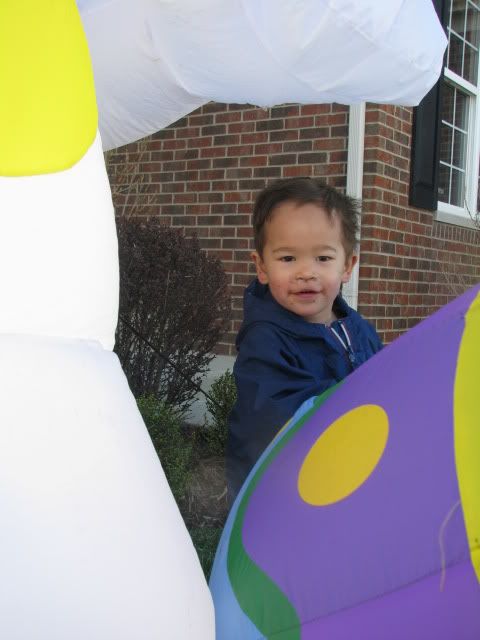 carrying him, of course. So once again I ran back (well, I could only run part of the way), and this time was able to get Alex's plastic bucket. We returned a few minutes before the start of the egg hunt. Maternal honor was restored--though my legs still ache a bit.
Alex really enjoyed the egg hunt. Since he was so young, he and the other little kids got a head start. I helped him gather some eggs. The candies and prizes were nicer than the ones the park district offered last year. Our neighbor also had the Easter Bunny stop by with bubbles for the kids. Alex preferred checking out the inflated Easter Bunny and his colored egg.
Surprisingly, Alex did not fall asleep after the egg hunt; must have been all the chocolate. We colored a few eggs that night, or I should say Alex did. He was very good with it; he was done before I even realized it, even though he dipped some of the eggs twice. Last year he banged the eggs together; this year, we did lose a couple when they dropped on the floor, but he was more careful with them. He did eat about one and a half of the cracked eggs.
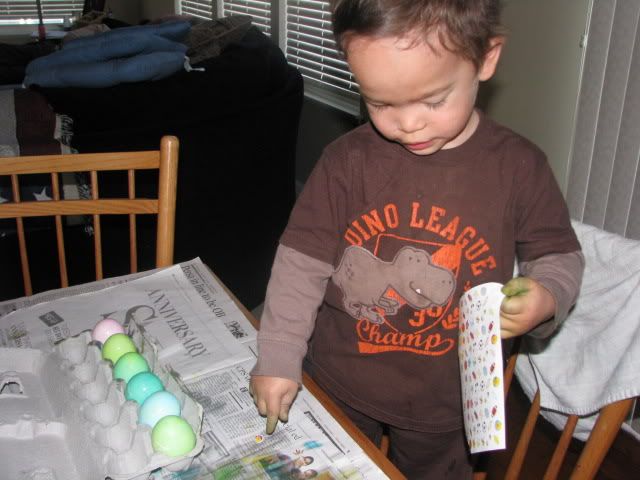
After he went to bed early (he was in meltdown stage by that point), I arranged his basket and hid it in his indoor tent. I left a trail of jelly-bean-filled eggs leading from his door to the basket. Alex generally wakes up slowly, but once he saw the eggs, he knew what to do. He was quite happy with his treats and his new additions to his Thomas the Train collection.
Later on, we had brunch with both families (my parents and grandmother; Eugene's parents and brothers) at a nearby banquet hall. Alex got spoiled, needless to say. In the late afternoon, we drove over to Eugene's aunt's house, where Alex was introduced to billiards. He already knows how to get into Trouble with a capital T!
Tomorrow, we will return you to your regularly scheduled writing posts.
Saturday, April 03, 2010
Blog Updates
I've added some new pages to my blog; the links are in the sidebar. One of them is a biography of me; the other lists my sales and awards. I may move some of the links to a separate page when I have more time.
Is there anything else you'd like to have me put on a separate page of this blog?
Is there anything else you'd like to have me put on a separate page of this blog?
Friday, April 02, 2010
Setting Priorities
I've decided I need to be four people. One to work, one to take care of Alex (though I think the stimulation he gets at daycare is good for him), one to cover domestic duties, and one to actually take care of me and write.
Scary to think so much is demanded of a single person, isn't it? But I'm sure I'm not the only one out there who's overworked like this. The reason I'm bringing this up is because today work is closed and daycare is open. Since dropping Alex off, I've gone shopping, swept and mopped the floors, vacuumed the upstairs, cleaned the master bathroom, made a dessert (which took longer than the recipe claimed), and baked two loaves of potato bread. Oh yeah, and done two loads of laundry (one's still in the washer; the other has to be folded). I said this would be my day to recharge my batteries, but instead I've spent most of it on other things. They needed to be done, and there's still much more I should do to make this place presentable. But I promised myself I would work on Across Two Universes today, so it's time to "just say no" to the rest of the chores. I've got a strawberry banana smoothie, retro tunes on Pandora, and red polish on my toenails. Time to sit in my office (which desperately needs to be organized too) and crank out some words.
My take-home lesson for you is to make time for you and your writing too. After all, the chores will always be there. Especially later, when my son returns home and promptly starts creating more messes.
Have a happy Easter, and enjoy your weekend! I'll be back soon.
Scary to think so much is demanded of a single person, isn't it? But I'm sure I'm not the only one out there who's overworked like this. The reason I'm bringing this up is because today work is closed and daycare is open. Since dropping Alex off, I've gone shopping, swept and mopped the floors, vacuumed the upstairs, cleaned the master bathroom, made a dessert (which took longer than the recipe claimed), and baked two loaves of potato bread. Oh yeah, and done two loads of laundry (one's still in the washer; the other has to be folded). I said this would be my day to recharge my batteries, but instead I've spent most of it on other things. They needed to be done, and there's still much more I should do to make this place presentable. But I promised myself I would work on Across Two Universes today, so it's time to "just say no" to the rest of the chores. I've got a strawberry banana smoothie, retro tunes on Pandora, and red polish on my toenails. Time to sit in my office (which desperately needs to be organized too) and crank out some words.
My take-home lesson for you is to make time for you and your writing too. After all, the chores will always be there. Especially later, when my son returns home and promptly starts creating more messes.
Have a happy Easter, and enjoy your weekend! I'll be back soon.
Subscribe to:
Posts (Atom)