Showing posts with label discussion. Show all posts

Wednesday, June 17, 2020

All We All Problematic?

I've been thinking a lot about John Scalzi's recent post about generations and discrimination. One of the points of his post is that each generation has to come to terms with their biases, and their targets may differ with each generation. Just as we deplore the sexism and racism of earlier generations, in time, other generations may find their own reasons to think we're unenlightened about subjects they value. Is it ever going to be possible to free ourselves from all biases?

Unfortunately, probably not, unless human nature changes dramatically. Here are a few factors discussed in Blueprint: The Evolutionary Origins of a Good Society. The more bonded we are to our in-group, the more we distrust outsiders. Humans require some leadership, but too much hierarchy or too much inequality leads to instability. According to Scientific American, wealth tends to become concentrated in the hands of a few over time. The more wealth you have, the easier it is to rig the scales in your favor--and perhaps even convince others that this situation is natural. We're also prone to implicit bias, though there are ways to overcome it.So if we all have biases, does this mean we're always going to have to deal with systemic discrimination?

I think this is really going to depend on how much empathy and open-mindedness we have. Open-mindedness is part of an individual's personality, but empathy can be developed, especially by reading fiction. We need to view ourselves as belonging to different groups and work to establish connections between them. We also have to learn about the ways we distort critical thinking to support our biases instead of viewing them objectively. This work may never be finished, but each of us is obliged to contribute. We become problematic when we fail to show empathy to others or change our minds when we're shown new evidence.

What do you think is the best way to tackle discrimination? Feel free to share your thoughts in the comments.

Wednesday, July 13, 2016

Cool Collaborations

I mentioned in Monday's post that my husband and I saw the Rock Paper Scissors tour featuring Sting and Peter Gabriel on Saturday. We were in the nosebleed section side of stage, or what I think of as the clap-your-hands section after John Lennon's quip "Will the folks in the cheap seats clap your hands, and the rest of you just rattle your jewelry." Eugene and I are happy enough just being able to hear the music. It was a great show, with the two musicians exchanging songs throughout the night. My favorite part occurred during "Games without Frontiers," when Sting and Peter Gabriel strolled down the stage together. I wasn't able to get a picture of that, so here they are during "Sledgehammer."

Watching the two of them together made me think about writing partnerships. I haven't co-authored a story with anyone, and since I'm a pantser, plotting together would be difficult. Still, I think one could learn a lot from working with someone else. If I could write a story with a famous science fiction/fantasy novelist, I think I'd pick someone like Patricia McKillip or Nina Kiriki Hoffman because I like their approaches to the genre. I'd love to work with Lois McMaster Bujold or Connie Willis as well, simply because I'd learn so much from either of them.

If you could pick a famous author to write with, who would it be and why? Alternatively, which authors do you think should have worked together? Feel free to share your thoughts in the comments.

Wednesday, July 06, 2016

IWSG: Comparisons

It's time for the July edition of the Insecure Writer's Support Group. Here are the co-hosts for this month:

Yolanda Renee
Tyrean Martinson

A new feature this month is a question everyone is supposed to answer in their posts. Here's the question: What's the best thing someone has ever said about your writing?

The most memorable compliment I've received came from a reader on Goodreads. She compared my short story "Silver Rain" to an O. Henry story. Considering how I struggle with short stories, that's a huge compliment.

While it's wonderful when a reader compares you to a highly regarded author, comparing your works to other books can make you feel inadequate. For example, I read Naomi Novik's Uprooted this weekend. I found the main character quite sympathetic, the world-building details convincing, and the plot gripping enough to make me take the time to read 400+pages in less than 24 hours. (I can't always take the time to devour books like that anymore.) After reading something like that, the rough draft of my current WIP feels inadequate, with weak verbs and little description.

How do I cope with comparisons? I remind myself that it's not fair to compare a rough draft with a finished work (because for some reason, one always compares your worst against someone else's best). In a first draft, I'm still feeling out the basic plot, so actions and dialogue take priority. Once I have a better sense of the scene, I go back in and layer in description. Oddly enough, it's easier for me not to compare my finished books with someone else's. There will always be things I will think of post-publication, but I'm less tempted to revise those works (probably because I'm in the middle of another project by then.) 

If anything, one should learn from what you read, both what works and what doesn't. Every book is unique, meant to appeal to a different audience. I think that's why it's so hard for me to pick a favorite book. Enjoy them all for what they are, and don't try to force them into being something different.

If you're an author, what's the best thing someone has said about one of your books? What's the best thing you might say about someone else's work? Feel free to share in the comments below. 

Wednesday, June 29, 2016

Barnes and Noble to Carry (Some) Indie Books

One of the disadvantages of being an indie author is difficulty getting your paper books distributed by physical bookstores. It can be done, but it might require printing your books through a different service and paying for returns. Barnes and Noble announced yesterday plans to carry select indie books in their stores (you can currently order indie paper books on their website). Here's the original article posted on GoodeReader; you can read commentary from other indie authors on The Passive Voice

While this sounds like a great deal for indie authors, it's necessary to consider the details. To qualify, the eBook versions must be published through Nook Press (which means I'd have to cease using Draft2Digital to distribute to B&N--and I can't set a book to permafree unless I use the distributor) and sell at least 1000 books a year. Most of my sales are on Amazon; I have very few on Kobo, Apple or B&N. I still distribute my books there partly to give my readers as much access as possible and partly because I don't want to be 100% reliant on Amazon. Even if a book does qualify, there's no word yet about terms, such as number of books per store, how long they will be displayed, and what the return policy for unsold books will be. While I see this as a step forward for indie authors, I also have my doubts about the long-term health of Barnes & Noble. If they manage to avoid going the way of Borders, they may be forced to do that by reducing their shelf space even further and selling things other than books.

Let's take a quick poll: If you buy paper books, where do you buy them from? Please feel free to comment below.

Wednesday, May 18, 2016

Do You Value the Goal or the Process?

Yesterday, I read an article called, "The Most Important Question of Your Life." According to the author, you shouldn't ask yourself what you want out of life, but rather what you choose to suffer to achieve your goals. No goal worth achieving can be reached without effort, often requiring more effort than is apparent when someone first chooses to pursue a goal. There can be physical or psychological pain experienced over and over before someone succeeds. Even then, you may be required to put in effort to maintain your goal, whether that goal is staying at a healthy weight or keeping a relationship strong. I think the author makes some valid points, but I think there's more to reaching a goal than enduring pain and suffering. The bumps are part of the journey, and while it's always important to keep a goal in mind, one has to accept the journey, even learn to enjoy it, to reach the goal.

One of my favorite all-time books is Zen and the Art of Motorcycle Maintenance. There's a passage in there where the author talks about trying to climb a mountain but giving up due to exhaustion. Physical strength and intellectual motivation weren't enough. To quote at length:

He didn't think he had been arrogant but thought he was undertaking the pilgrimage to broaden his experience, to gain understanding for himself. He was trying to use the mountain for his own purposes and the pilgrimage too. He regarded himself as the fixed entity, not the pilgrimage or the mountain, and thus wasn't ready for it. He speculated that the other pilgrims, the ones who reached the mountain, probably sensed the holiness of the mountain so intensely that each footstep was an act of devotion, an act of submission to this holiness. The holiness of the mountain infused into their own spirits enabled them to endure far more than anything he, with his greater physical strength, could take....[The ego-climber] rejects the here, is unhappy with it, wants to be further up the trail but when he gets there will be just as unhappy because then it will be "here." What he's looking for, what he wants, is all around him, but he doesn't want that because it is all around him. Every step's an effort, both physically and spiritually, because he imagines his goal to be external and distant.

In other words, if you want to write a book, earn a degree, or accomplish something, you have to value getting there as much as achieving the end goal. Of course, different people have different tolerances and so may therefore need to take different journeys. I don't enjoy running so would never set out to run a marathon. However, I do enjoy the process of researching stories, developing plots and characters, and putting in a day's work on a manuscript, so I can achieve my goal of writing a book. Someone else may be able to run a marathon but loathe having to sit at a computer and write all day.

  What do you think? Does success in reaching a goal depend on accepting setbacks along the way, recognizing the value of the journey, both, or something else? Do you think this could be part of the reason why so many books include a journey as part of reaching a goal? Feel free to share your thoughts below.

Wednesday, August 12, 2015

Are You Part of Your Marketing Audience?

I stumbled across this blog post by Patty Jansen on Tuesday, and it got me thinking. It's titled "Why you are the biggest impediment to selling your books," and I recommend you read it. The gist is that authors may settle for poor marketing advice from their friends, or even follow their own tastes, without realizing that they're not part of their target audience and so aren't reaching them. Sometimes authors may be unwilling to experiment with their marketing techniques or be aggressive enough with their marketing. The point Patty ends up making is that you should pay attention to how successful people market their books, not how you want to be marketed to. I guess this is a new version of the Golden Rule: Don't market unto others as you want done to you.

Patty also concludes with the point that "You are not in your target group." I admit I find this line baffling. Aren't you supposed to write the books that you care about? Wouldn't that make you part of your own target audience? Or does she mean that you have to reach people with a certain set of behaviors you are unlikely to share? I imagine these are the people who not only like your book but are well-connected and are good at providing the word-of-mouth recommendations writers need. I'm still not sure what's the best way to target such people, though.

Are there certain marketing techniques you refuse to use? If so, what are they? Did you try them out before dismissing them?

Wednesday, July 29, 2015

Amazon Bestseller Status--Empty Brag or Not?

Yesterday, one of the science fiction authors (who shall remain nameless) I follow on Facebook posted a mini-rant about how some (presumably "indie scum") authors claim bestseller status from Amazon sales when those numbers don't compare to the ones needed to make bestseller status in the NY Times or USA Today. I didn't post a response then because I needed to focus on my writing and not argue with someone on his own Facebook page, but I think the topic merits further discussion.

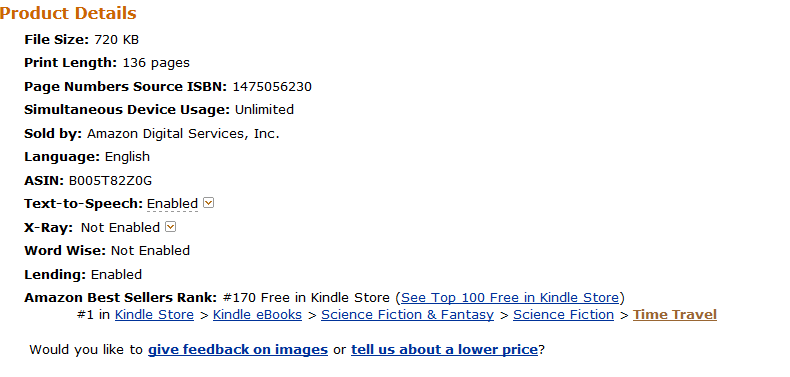
Lyon's Legacy has made Top Ten in the Time Travel category on Amazon a few times, mostly when I put it on sale and advertised it on Book Gorilla. The first weekend it was permafree it also moved a lot of units without paid ads and reached #170 on Amazon overall for free books. Granted, each time there were only a few hundred units involved, and of course after a few days the novella slipped down the charts again. Other works of mine, such as "Letters to Psyche," Life at Seventeen Syllables a Day, and even SF Women A-Z also made it into the best-seller list for more obscure categories briefly with only a couple of sales. So, yes, I will grant this author the fact that Amazon bestseller status for an hour or two for a subcategory does not necessarily match numbers with bookstore sales generated over a week.


Is Amazon bestseller status misleading or meaningless, though? The author who complained about this is a well-known, award-winning author who shouldn't feel threatened by indie authors like me, who only make a handful of sales each month. For me, it is exciting to see a book climb the charts, even if I know it won't last. (However, when overall sales are slow, Lyon's Legacy can still linger for a while on the free Time Travel bestseller list with few sales, albeit near the bottom.) I do list Lyon's Legacy Top Ten Time Travel bestseller status in its book description on Amazon since I think that is a significant accomplishment. Maybe it came about after an ad, but then publishers pay bookstores for prominent placement of featured books, so they also invest in that status.

As for other bestseller lists, they can be gamed by people who know which bookstores are counted when compiling those lists, and the list-makers have been known to manipulate the lists to keep eBooks and the Harry Potter series off of the lists. Barnes and Noble has been accused of deliberately suppressing the ranks of indie books in certain genres so they don't compete with traditionally published books. Amazon can be gamed too, but in my opinion, it is the most honest, transparent store when it comes to its bestseller lists.

Bestseller status is important to big publishers and their authors, since they profit most when they sell lots of copies of a single title in a short time. Indie authors with lower overheads can make money off of fewer sales sustained over a long period of time. While it looks nice to be a bestseller, in the long run, I would like to have sustainable sales supported by true fans and word-of-mouth. It may take a lot of sales to many different people to reach my target audience, however.  I will only mention bestseller status for my works in the book description if it makes it to the Top Ten of its category. And while it's hard to avoid comparing yourself with others, for my own career, I'd rather focus on writing and publishing the best books that I can. As a reader, I'm too independent to read something just because it's a bestseller, but I realize others might value that popularity.

How do you feel about bestseller status for books? Does it matter to you as a reader? Do you care how the bestseller status was earned?

Monday, July 27, 2015

How Much Character Pain Can You Read About?

I started reading Jo Walton's All My Children last week, but after I started it, I put it aside for a couple of days. There was a section that I didn't want to read because the protagonist was trapped in a miserable marriage. Fortunately, once I got past that section, her life improved. Still, it got me thinking that while we as writers are supposed to make life tough for our characters, it's possible to put them in so much emotional pain that it becomes uncomfortable for the reader. Two writers who really inconvenience their characters are Jim Butcher and Laura Resnick. It's not enough that their characters have to fight some bad guys, but oftentimes they have to do it while being up all night, dressed in something inappropriate, and needing to use the bathroom, all at once. Sometimes I find the trivial issues (like the wrong outfit) distracting from the major conflict. As a mother, I don't like reading about kids in jeopardy either.

Are there types of conflict or emotional pain that you don't care to read about? Feel free to discuss them in the comments section--if you don't mind doing so, that is.

Wednesday, July 15, 2015

Who Are Your Bookshelves For?

Last week on The Passive Voice, there was an excerpt from the article "Paper Chasing" on thepointmag.com about books and book collecting. The author of this piece seems to think that collecting and displaying books, not just reading them, is a major part of books' appeal to serious readers. While I do have more books than the average person (I don't have an exact number, but the total is probably close to a thousand), I know there are people who have even more than that, who have rooms of books and not just shelves.

I lived in apartments for a good chunk of my adult life. With limited space, I sometimes had to purge my shelves of unwanted books before I could bring more in. Moving every few years also gave me incentive to trim my collection down, especially when I had to haul boxes of books up and down stairs. Even now, when my current house has triple the square footage of my last apartment, I still feel I need to limit the amount of physical books and bookshelves in the house. I've lost books in a couple of basement floods, so I don't feel comfortable keeping them down there, even if we had a finished basement. Perhaps this explains why I don't mind buying eBooks or borrowing books from the library. For me, the reading experience is more important than the physical act of collecting books. That doesn't mean my physical books are unimportant. I use a picture of one of my bookshelves on this blog, and the books I've kept do bring back memories of the stories or the authors. However, after I delete eBooks from my Kindle, I can remember them by associating them with the places I read them. My eBooks are never gone; they're just in Amazon heaven.

My bookshelves are more for me than anyone else. We do have some nonfiction books in the study downstairs, but the bulk of my books are in my office upstairs. I don't buy popular or prestigious books simply to impress other people. I buy books that I think I might like, and if I do, I may keep them. If not, they get resold. I don't expect my son to want to hold onto my books once I pass, but I do hope they find homes with other readers who like them.

How do you feel about collecting books? Do you hold on to physical books? Have eBooks changed your feelings about paper books at all?

Wednesday, June 17, 2015

Selecting KDP Select or Not?

A couple of days ago, Amazon announced a major change to how authors in the Kindle Unlimited program would be compensated. When KU was formed last year, authors were paid if a reader read past 10% of the book length. This led to a lot of authors putting short stories and serials into the program. To encourage authors to add longer books, Amazon will start paying them next month by the number of pages read.

Currently, I only have one short story, "Letters to Psyche," in Select. I prefer to put my work in wide distribution, both to benefit readers and to make sure each book has the potential to give me multiple income streams. That said, most of my sales do come from Amazon. I get a few by distributing through Draft to Digital, even less via Smashwords, and so far none through Google Play. I have put some of my work in Select for brief periods of time. For example, Seasons' Beginnings was in Select for the first three months before I put it in wide distribution. I got a few borrows, but it wasn't hugely popular. However, I put Scattered Seasons in wide distribution from the start because the first book was available everywhere. Since there is a big shift in the Season Avatars series between books One and Two, I plan to write a short story collection featuring the characters from Scattered Seasons and use that as a way to introduce readers to the series. The question now is whether I should make the collection perrmafree everywhere or put it in KU first and see how it works. I face the same decision with "The Unnumbered World," the next story in the Catalyst Chronicles series. All novels from both series will be in wide distribution, but at some point, I may write another series and keep it exclusive to Amazon.

What do you think of the KU Program? Are you signed up for it as a reader or writer? Please let me know in the comments.

Monday, June 15, 2015

New Women in Science Fiction Project

Remember my SF Women A-Z series back in April? Well, apparently I'm not the only one with a project to promote women SF authors. Writer/editor Kristine Kathryn Rusch is working with Baen Books to create an anthology (in several volumes) of short fiction by classic SF women authors. You can read more about her project here and suggest authors/works on the associated website. For more background about why this project is necessary, check out Rusch's latest Business Musings, in which she describes how publishing's need for bestsellers led to rapid churn of the books carried by bookstores. This in turn means bookstores are less likely to carry backlisted titles. Even libraries end up culling unpopular books from their shelves to make room for new ones. We're fortunate that these days classic stories can be made immortal in digital format so they're not forgotten.

Are there any classic but "forgotten" SF stories that you think should be read by contemporary readers? If so, please list them in the comments.

Wednesday, June 10, 2015

Reading the Hugo-Nominated Novels

I'm a supporting member of this year's Worldcon. My main reason for registering, of course, is to vote for the Hugos. So far I've read four of the five novels, three of the novellas, and two of the novelettes (I'm currently working on a third.) Here are some of my thoughts on the novels. I'll try to avoid spoilers, but it may be hard to discuss some points without details--or the politics behind the choices.

The Three-Body Problem--This is an English translation of a Chinese novel (so it counted for my Diversity Read last month). It starts during the Chinese Cultural Revolution and goes up to the present day, though the story line skips around a bit. A young woman scientist gets caught up in political affairs and ends up working on a top-secret project to contact aliens. Embittered by her father's death, the woman invites aliens from an imperiled planet to invade Earth. The aliens use a variety of scientific and psychological tricks to prevent Earth from mounting a resistance. This is the first book of a trilogy, so the outcome isn't decided in this book. I found the characters flat at first and found this book initially difficult to get into. Once the Three-Body Problem game was introduced, it picked up. Still, some subplots of the story felt like they got dropped after that point (maybe they'll be picked up in the next books), and to me, while some of the aliens' plans pose interesting questions about the nature of science, they also seem like some over-the-top plan from a James Bond movie to kill the agent (i.e., too complicated when a simple plan would be more effective). The science part overshadows the fiction to me.

The Goblin Emperor--The half-breed fourth son of the elven emperor succeeds to the throne when his father and older brothers are all killed at once. He was never expected to become emperor, was disliked by his father, and sent away to a remote area without proper training for his role. As soon as he learns the news, he proceeds to the capital to take the crown before he can be killed or manipulated. However, he has a lot to learn about how his court works, and his temperament is much different from his father's. This is a slow-paced book with lots of characters that are hard to keep straight. I still enjoyed seeing the title character grow into his role.

Ancillary Sword--The sequel to Ancillary Justice,which I read last year. This story continues to use female pronouns and quick POV shifts within scenes as in the first book. (The main character used to be the brains of a spaceship, able to sense everything through its ancillary crew, but is now confined to a single human body.) The main character is now commander of her own ship and takes on a mission to another planet on behalf of the Lord of the Radch. An interesting story, but I'm not sure how it's advancing the overall plot of the trilogy.

The Darkness Between the Stars--Although this is the first book of a series, it's set after another seven-book series which I haven't read. Apparently it features a lot of characters and families from the previous series. There's a lot of backstory which slows things down, and again there are so many characters it's hard to keep track of them all. Chapters are short and mention the name of the POV character, which helps a lot. Still, in an epic story like this, some storylines and characters get more space than others. (Some of them don't seem necessary to me, but they may have been more important in the first series.) The story is set about twenty years after a major war in space and shows new hostilities rising up again. Some of the aliens, such as the world trees, seem to be a SF counterpart to the traditional fantasy elements of earth, air, fire, and water. (I see at least three elements in the book, but I'm not sure how air is represented.) Characters can be a bit one-note and stereotypical at times.

Skin Game--Part of the Dresden Files series. I've read some of the series, but I'm not up-to-date on it. This makes me reluctant to read this work (the voting packet does not feature the complete book) for fear of spoiling the books I haven't read yet. Still, I'm trying to give all the nominees a fair read (I admit I'm not objective--that's why I registered to vote in the first place), so I may have to borrow it from the library if available.


Have you read any of these books? If so, what did you think of them?

Wednesday, May 20, 2015

Take Off Your Pants!

The title doesn't refer to clothing, but to a writing method of working without a plan, more commonly known as "pantsing," for writing by the seat of your pants. I tend to write like this myself, but this often means it takes several drafts for me to come up with a workable plot. That said, I've tried outlining before but haven't been very effective with it. Writing projects more quickly and with fewer drafts would allow me to increase my output (which is important for indie authors who want to earn a living) and take care of all the projects I have in mind but don't have the time for. So I thought I'd read Take Off Your Pants! Outline Your Books for Faster, Better Writing by Libbie Hawker. She says in the beginning of this book she was able to write a complete book in three weeks with this method. I don't think I could manage that with a day job and a school-age son, but I'd like not to take months or even years either.

In my previous attempts at outlining, I always started at the beginning of the book and listed the main events of the plot in order. Hawker takes a different approach by first focusing on the emotional journey of the main character. According to her, the point of the story is the main character's personal growth as she learns to overcome a flaw. So, with Hawker's approach, you would first develop the main character, the weakness she must face, and the external goal that will force her to grow. From there, you would develop other characters, the theme, and a couple other aspects of the story. Finally, you would come up with the events of the story, using the Hero's Journey as a template. Another key part of plotting is pacing, and Hawker describes a technique to keep readers hooked.

There are a few things about Hawker's method that I didn't agree with. Some stories and genres don't seem to focus on character growth. For example, the detective in a mystery series, like Sherlock Holmes or Miss Marple, doesn't develop much, if at all, over the story. This type of story focuses in ideas, not characters. Also, Hawker states that an antagonist typically wants the same goal as the protagonist, as if they're competing for a prize. I don't think that's always the case. Nonetheless, she's more experienced at outlining than I certainly am. Even though I'm already halfway through Chaos Season, I'm going to try this method to develop the second half of the novel and plan the parts in the first section that need changing. At the same time, I'll also work on outlines for the final two books in the series, Fifth Season and Summon the Seasons. This will be tricky, as a different Avatar is the main character of each book, yet some characters will continue to develop after "their" book is over. Good thing Hawker's method can be used for books with multiple main characters too.

For the writers out there, do you plot or pants? If you plot, what do you think of Hawker's method? Readers, do you feel character growth is always more important than action? Why or why not?


Monday, March 30, 2015

Reading and Writing Updates

The A-Z Blogging Challenge starts on Wednesday! I'll have to sneak in a few posts about Scattered Seasons during April, but for now I can report that I'm just waiting for the paper cover before I order the proof. You can pre-order the eBook on Amazon, Barnes and Noble, Kobo, and iTunes. I have most of the promo ads lined up and am also going to start a Thunderclap campaign to announce the release. More details will be coming out when that's launched.

In the meantime, I'm continuing to work on the first draft of Chaos Season, Book Three in the Season Avatars series. I'm also planning to prepare a mini story collection featuring the four Season Avatars before the events in Scattered Seasons. This would be a permafreebie to introduce the series to readers (in addition to Seasons' Beginnings, of course.) Two stories are already written, so I'm working on the other two. After I get one of these projects finished, I'll have more time to work on the next story in the Catalyst Chronicles series, which will feature a minor character from Twinned Universes and be a bridge between that book and Book Three, Catalyst in the Crucible. Short stories are harder for me in some ways than novels, but I would like to get more written so I can put them in a collection and prepare a print edition.

Do you remember the reading challenge issued back in February to stop reading books by a certain type of author for (straight white males) a year? I've been mulling it over and decided I would find that challenge frustrating, even if I shortened it to a month. (I could read twelve books in a month, which would be equivalent to reading one book a month for a year.) I read for entertainment and education, and I generally don't research an author before deciding to read a book. I also don't like being forced to read only a certain type of author, as that would give me reason to resent their work. I already read a lot of women authors, though I don't exclude men either. What I think is more sustainable in the long run is to be more open to reading authors whose background differs from mine in some significant way, such as racial, ethnic, nationality, or class. I could try to read at least one book a month from an author that fits that description while continuing my normal reading. I've already done one for March; now I have to pick one for April.

So, how are your projects going? Feel free to share in the comments.

Sunday, March 22, 2015

eBook Prices


Last week, a book from one of the authors I follow on Goodreads came out. The announcement said the eBook was available for a “special introductory price,” so I checked it out on Amazon. Do you think the price was 99 cents? $4.99? No, it was $9.99. I closed the tab without even downloading the sample and headed over to my library’s website to put the book on hold.

Everyone has different price ranges they’re comfortable with. For me, I have no problem with prices of $4.99 and below for fiction and nonfiction, though I generally read the sample first before deciding to buy. (I may buy the book outright if it’s a nonfiction book on sale or if I’m familiar with the author’s work.) If I’d read the author before and consider myself a fan, I’m willing to go a little higher, maybe up to $7.99. 

Any price that’s higher than a paperback for a novel, however, is more than I’m willing to pay. At the speed I read (more than 200 books a year), I can’t afford to read $9.99 eBooks. They’re not a good value for me, especially if I’m going to read the book once and remove it from my Kindle to conserve space. Even $7.99 may be daunting if the book is part of a long series and I would have to pay over $100 to read the entire series. At that point, I will borrow the book from the library if possible, look for cheap secondhand paperbacks if the book has been out for a while, or simply skip the book and quietly rejoice at being able to shrink my immense TBR list.

I’m willing to spend over $10 on non-fiction eBooks, particularly if I think it will be useful for writing. Since non-fiction is only about 20-25% of my reading, and not all my non-fiction costs that much, I can manage the occasional splurge. 

If you read eBooks, what price ranges are you comfortable with? Does the subject matter or familiarity matter?

Tuesday, March 17, 2015

Facts for Fiction: The Copernicus Complex

Yesterday I finished reading The Copernicus Complex: Our Cosmic Significance in a Universe of Planets and Probabilities. Long ago, people used to think the Earth was the center of the universe until Copernicus showed the Earth revolved around the sun. These days, it seems obvious that we're just a Johnny-come-lately species stuck on an infinitesimal rock going around an average star in an average solar system...or are we?

This book attempts to help humanity figure out its place in the universe by looking at everything from the formation of solar systems to the beginning of life.  Among other things I learned from this book is that our solar system is unusual compared to others that have been found around other stars, the inner planets of our solar system may not have stable orbits (Mercury could crash into the sun, or Venus into us), and megaviruses may have devolved from other life forms. Altogether, the evidence suggests that we do occupy a special niche in the universe, but our ultimate significance to the universe depends on how much we explore the universe, even if we have to do it by machine instead of in person.

Although this was an interesting book to read, it's not a research book full of information I can use in my own stories. It is useful to step back every now and then to look at the big picture--and you can't get a much bigger picture than this.

Do we dare disturb the universe? Feel free to comment below.

Wednesday, February 18, 2015

Line Edits: Eight Ways to Reduce Your "Buts"

I had Monday off, so even though my son was home too, I managed to finish the first set of revisions of Scattered Seasons. (It's with beta readers at the moment. I already heard back from two of them, and I should get the rest of the comments by next month.) Most of the revisions were minor, but I had to remove a lot of "buts," not just from the middle of sentences, but also when I used it as the first word. The reason I wound up removing "buts" is because there were places where I used three or four of them close together, and it distracted my beta reader. All before and after comparisons listed below are from Scattered Seasons.

Most of the time, "but" is used to join two independent clauses into one compound sentence. In those instances, there are three obvious ways to eliminate the "but":

1. Split the compound sentence into two simple sentences.


(Before) “The Hall of Records in Wistica sends us information about future Avatars when they're born, but we’ll have to search through her office for the records.”   


(After) “The Hall of Records in Wistica sends us information about future Avatars when they're born. We’ll have to search through her office for the records.” 

2. Replace the "but" with a semicolon. (This may change the relationship of the sentences. Some people feel that semicolons don't belong in fiction; I say they can work if handled properly.)


(Before) She must have done it in other lives, but would she be able to do it in this one?


(After) She must have done it in other lives; would she be able to do it in this one?

 3. Replace the "but" with a semicolon and a "however," with a comma after "however." (This approach keeps the meaning intact but still bothers the semicolonphobes. I'm sure I had an example of this; however, it would take too long to find it again.)

If you're willing to rewrite your sentences, you can come up with some other ways to remove the "but."

4. Rewrite one of the independent clauses. (In the example below, I moved a phrase from the second sentence to the first. I had some other examples where I made the second clause dependent on the first.)


(Before) Aunt Gabri joined them as well. Her color was too pale, but she watched Kron as if she shared Gwen’s suspicions.


(After) Aunt Gabri joined them despite her pale complexion. She watched Kron as if she shared Gwen’s suspicions.

5. Change the "but" to an em dash. This may require a rewrite.


(Before) She wished she could study the pot close-up, but she wasn’t sure if it was safe to do so. 


(After) She wished she could study the pot close-up—if it was safe to do so.


Finally, you can remove the word (6) (if it's at the beginning of the sentence), one of the independent clauses (7), or the entire sentence (8). Here's an example of number 7:

(before) I understand, dear, but you keep driving and driving yourself without a break. 

(After) You keep driving and driving yourself without a break.  

I wound up removing between a third and a half of the marked "buts." Of course, I'm still sensitive to the word and keep finding more instances that no longer feel appropriate in context.

Are there any particular words that bother you when they're used too much?

Site Meter