I became a fan of MCA Hogarth's after impulsively backing one of her projects on Kickstarter. Since then, I've been working my way through her books (I just finished Either Side of the Strand last week), but I haven't followed her blog very much. That's a shame, as she offers advice about business management for artists there. In 2013, she put this advice into the mouths of three jaguars--Artist, Marketer, and Business Manager--and into a web comic. The format didn't work as well as she'd hoped, and it didn't run very long. I was disappointed when I found the web comic on her page and realized she wasn't drawing it any more. So when I learned she put the collection out in paperback form, I immediately bought it. You can buy The Three Jaguars: A Comic About Art, Business, and Life at the link.
In this comic, Hogarth introduces us to the three jaguars listed above, each representing a different hat the artist-businessperson has to wear. (The Artist in this book both writes and draws, just like Hogarth.) Together they give advice on such issues as publicity, contracts, negative art, politics, and more. Each character has a distinct personality and different skills. Artist tends to come across as the most naive of the three, as the others have to explain things to her constantly. (On the other hand, without Artist, there would be no need for Marketer or Business Manager.) Hogarth makes her points with humor and cuddles. While this book can't offer advice on specific ways to improve your marketing or how to manage your business, it does illustrate what marketing needs to do, what makes contracts bad, why you should be careful not to discuss politics online, and so on.
Award-winning artist Ursula Vernon says this book is "better than setting your house on fire and fleeing overseas!" (She really does, and it's on the front cover. Read the Foreword for more context.) If you're an artist trying to turn your work into a business, or if you know someone who is, I recommend this book.

Monday, August 31, 2015


Friday, August 28, 2015
Science of the Week: 8/28/15
Today is my son's first day of third grade. Trust me, it'll be newsworthy if we can get him to school on time. (Of course, with first day excitement, we usually do manage to get there before school starts, but it becomes more difficult as the year goes on.)
Here are some of the most interesting science news articles I read this week:
Black holes aren't as black as thought
(Information is stored on the event horizon and so can escape, but it's still useless, according to Stephen Hawking. Unless the information makes it to a parallel universe...)
Researchers identify signature of microbiomes associated with schizophrenia
Crash-tolerant data storage could lead to computers that never lose your data
Blood cleaning device scrubs toxins, pathogens, from the red stuff
Intractable pain may find relief in tiny gold rods
A metabolic master switch underlying human obesity
Driverless cars will change the world, but how exactly?
Hunger drives unethical acts, but only in the quest for food
Have a good weekend, and I'll see you Monday!
Wednesday, August 26, 2015
Kindle Editing
I've decided it's time to start editing Chaos Season, the next book in the Season Avatars series. The first step I take in editing is rereading the entire work. These days, I like to do that on my Kindle. By sending it to my Kindle, I can read it in a different format so I can read it with a fresh eye. I can also check formatting at the same time. Whenever I see something I want to add, change, or delete, I highlight it and type a note. It works well for line-item edits but not so well for larger edits, which is what I should really be working on at this stage. However, I can at least take mental notes of sections I want to change. Even though I need to revise the opening chapter (it currently starts right at the end of Scattered Seasons; I need to move the action forward a bit to skip some of the less interesting bits), I still wound up making a lot of line comments on lines that will probably be deleted. It may not be the most efficient way to edit, but I may be better at seeing smaller issues than larger ones. I may need to outline the current draft to check for other plot problems before I revise.
How do you edit your work? Do you use a Kindle or some other way to view it differently?
How do you edit your work? Do you use a Kindle or some other way to view it differently?
Monday, August 24, 2015
My Thoughts on the Hugos
Although I bought a supporting membership for WorldCon this year and voted, I didn't stay up to catch the livestream of the Hugo Awards. You can get a sense of what it was like by reading io9's liveblog of the event. It sounds as if some of the skits and special award presenters (especially the dalek) made quite an impression. However, what many of us were wondering and worrying about was whether the Puppies' nominees would win. You can find the list of nominees and winners on the official site for the awards, and only one Puppy nominee (Guardians of the Galaxy) won. "No Award" took five categories, especially the ones stuffed with Puppy nominations. Here are my thoughts on the other winners:
Best Novel--The Three-Body Problem--I discussed this book in my previous post about reading the Hugo nominees. Although the intellectual heft of the science ideas in this book are worthy of the Hugo, I didn't feel they worked well in the story. To me, the way the aliens use these ideas during their invasion of Earth are James-Bond-villianlike in their being over-the-top. Surely aliens with this level of technology (and I was surprised they had it because they were initially portrayed as being behind humans) could come up with more efficient and effective ways of dealing with humans. I would have preferred The Goblin Emperor on a story level for the win. However, The Three-Body Problem is the first translated novel to win a Hugo and thus makes this award more accessible to foreign novels.
Best Novella--No Award--I didn't care much for the works in this category. Some of them felt like excerpts of longer works and probably shouldn't have been in this category to begin with.
Best Novelette--"The Day the World Turned Upside Down"--The central metaphor was overbearing in this story, but it was the best of the finalists and the one I voted for. As in the Novella category, some of the nominated works felt like part of longer stories and didn't belong on the ballot, IMO.
Best Short Story--No Award--Another category dominated by Puppy nominees. I did vote for "Totaled," as I thought that story the best of the nominees.
Ms. Marvel #1--I had a hard time picking between this one and Saga for the Graphic Story category. In the end, I thought the characters in Saga were more complex and interesting, so I voted for that one. To me, some of the characters in Ms. Marvel seemed to be a bit one-note, such as the very religious friend or the clueless blonde concern troll. (The main character, however, did do a good job of questioning her identity and what it meant to be a Muslim-American superhero.) I did like how the parents tried to talk to their daughter to find out what was going on, as it seemed as if they were growing beyond the way they first appeared. Giving the Hugo to this graphic novel is a big step forward for diversity.
Editor Categories--No Award--I was a little surprised that these categories got "No Award," as some of the nominees are well-known professionals. Unfortunately, it appeared both categories were also compromised by ballot stuffing. I will admit that one of the nominees for the Long Form turned down the early draft of Day of All Seasons, my first attempt to tell the Season Avatars' story. I ranked him lower not so much for rejecting me (I had very little writing experience when I wrote that one, and it showed despite my revisions), but for promising to give me feedback and never following up on that. I did rank him above "No Award," though.
I don't follow the other categories and therefore didn't vote in them.
If the nomination process hadn't been messed up this year, the final ballot would have had more diverse works (see here for an analysis). The important thing now is to continue to read widely and think of possible works to nominate for next year. One thing I am trying to do is read more short fiction. I should track the stories somewhere so I remember them in 2016. I'm also open to nominating indie works, so we'll see if any of them make it to the final ballot.
How much did you follow the Hugo controversy this year? What works have you read or seen so far that you think deserve a nomination?
Friday, August 21, 2015
Science of the Week, 8/21/15
Here are some of the most interesting science news articles I read this week:
Turning atmospheric CO2 into carbon nanofibers could reduce global warming
(No idea yet if this project can really scale up, if it could stop or delay a process already in motion, or what other repercussions it might have. But if it can give us hope for the future, I'm for it.)
Apes may be closer to speaking than many scientists think
Young, Jupiter-like planet discovered
Paleobotanist identifies what could be the mythical "first flower"
Engineers develop a wireless, fully implantable device to stimulate nerves in mice
How to improve students' critical thinking about scientific evidence
How having racially diverse friends can help you on the job
Molecular scientists unexpectedly produce new type of glass
Lab-grown brain-in-a-dish as complete as 5-week old fetus
To detect dark matter we might need a different approach
Brown fat implants cut weight gain in mice
Have a good weekend, and see you Monday!
Wednesday, August 19, 2015
Spike The Corpse Flower
My husband and I used to be members of the Chicago Botanic Garden. We would normally visit two-three times during the summer, and we even had wedding pictures taken there. Unfortunately, we can't get out there very frequently anymore, though we still try to see the inside model train exhibit during the holidays. However, there's one special event we haven't seen yet: a blooming corpse flower. Spike, the corpse flower at the Chicago Botanic Garden, is due to bloom any day. (There's another corpse flower in Denver named Stinky ready to bloom too. According to this article, the flowers are even tweeting to each other. Amazing who's on Twitter these days.)
No one is quite sure when Spike will bloom, though it could be tonight. The garden plans to be open until 2:00 a.m. the day of the bloom. I don't have the stamina these days to get up in the middle of the night (though I'd still be awake anyway) and drive nearly an hour to smell something terrible, so I'll just have to settle for following Spike at this link.
How familiar are you with the corpse flower? Have you seen or smelled on in person?
Monday, August 17, 2015
Which Heroes and Heroines Make the Best Role Models?
I'm currently reading How to Be a Heroine: Or, What I've Learned From Reading Too Much, by Samantha Ellis. The author takes us on a literary tour through her life on the books she read during different times, how the various heroines influenced her, and how well they stand up to rereads and analysis. Although I haven't read all the books she discusses, it's still interesting to read.
Ellis used different literary heroines as her role models at different stages in her life. For me, I don't think I've ever done that to the conscious extent she did. Heidi was probably the closest I came to a literary role model in middle school and early high school. At this point, I'm not sure what drew me to her; perhaps it was her innocence and simple happiness. She may have helped influence my interest in religion at that point in my life. Other heroines I read about fairly extensively include Dorothy from the Oz series and Nancy Drew. There have been other books and series I've enjoyed a lot, such as Lackey's Heralds of Valdemar series, but perhaps I've read so many different books that each one has a small effect on me. It might be more accurate to say that like Walt Whitman, "I am large, I contain multitudes." It's a rare book that can stand out above that crowd.
Are there any heroes or heroines who were role models for you? If so, who are they, and what drew you to them?
Friday, August 14, 2015
Science of the Week, 8/14/15
Here are some of the most interesting science news articles I read this week:
Fermilab experiment sees neutrinos change over 500 miles
(I visited Fermilab during high school and am glad it's still in active use)
Abusive men put female partners at greater sexual risk, study finds
Here's what science is learning about zombie cells
(They're talking about cells with disrupted DNA)
Parental experience may help coral offspring survive climate change
Salt flat indicates some of the last vestiges of surface water on Mars
Loss of altruism (and a body plan) without a loss of genes
C-sections could influence babies' ability to focus
Paving the way for a faster quantum computer
Don't panic, but the universe is slowly dying
(not to depress you or anything)
You can get cautiously excited about this fusion power "breakthrough"
Octopuses "are aliens," scientists decide after alien study
Competition from cats drove the extinction of many species of ancient dogs
(this should be no surprise)
Could flu someday be prevented without a vaccine?
Algorithm aims at combating science's reproducibility problem
Humans responsible for demise of gigantic ancient mammals
Tetris can block cravings
Grammar: eventually the brain opts for the easy route
(but I refuse to give up my Oxford comma!)
Have a good weekend, and see you on Monday!
Wednesday, August 12, 2015
Are You Part of Your Marketing Audience?
I stumbled across this blog post by Patty Jansen on Tuesday, and it got me thinking. It's titled "Why you are the biggest impediment to selling your books," and I recommend you read it. The gist is that authors may settle for poor marketing advice from their friends, or even follow their own tastes, without realizing that they're not part of their target audience and so aren't reaching them. Sometimes authors may be unwilling to experiment with their marketing techniques or be aggressive enough with their marketing. The point Patty ends up making is that you should pay attention to how successful people market their books, not how you want to be marketed to. I guess this is a new version of the Golden Rule: Don't market unto others as you want done to you.
Patty also concludes with the point that "You are not in your target group." I admit I find this line baffling. Aren't you supposed to write the books that you care about? Wouldn't that make you part of your own target audience? Or does she mean that you have to reach people with a certain set of behaviors you are unlikely to share? I imagine these are the people who not only like your book but are well-connected and are good at providing the word-of-mouth recommendations writers need. I'm still not sure what's the best way to target such people, though.
Are there certain marketing techniques you refuse to use? If so, what are they? Did you try them out before dismissing them?
Monday, August 10, 2015
A Writer's Retreat--From Home
Normally when I take a day off from work to write, I spend the day at home. Last Friday, however, I took the opposite approach and hung out elsewhere. I had to run a couple of errands first, so I didn't get to start as early as I planned. (It didn't help that I had to drive to the other side of town on a wild goose chase, though I picked up something I needed on the way back.) Still, by 10:00 or so I was at my first planned stop of the day: a coffee shop.
I'm currently juggling four different stories, and my goal for Friday was to get past the 10,000 word count for two of them, Fifth Season and "The Unnumbered World." I not only broke that word count for Fifth Season at the coffee shop but went nearly another thousand words past that. I had lunch, did a little window-shopping, and headed to my next destination--the library. It wasn't that close to the coffee shop, but I had a couple of books to return, I wanted to admire the scenery, and it was closer to my son's daycare.
The afternoon session was more difficult than the morning one. Part of the problem was a lack of working power outlets--I had to switch seats three times before I could charge my netbook, which was running low by that point. Although I had some ideas thought out for "The Unnumbered World", the story wound up heading in a different direction and didn't come easily to me. Eventually I did make my goal for that story and switched to the "Young Seasons" short story collection. I was able to make some progress on an untitled short story that I'd been stuck on for a while.
Altogether, my writing total for the day was about 3,600 hundred words, with an additional hundred words or so added before bedtime. Some weekdays I can't even make it to a thousand words, so I was pleased with my productivity. I'll have to try going out again the next time I take a writing day, but hopefully I won't have to move around so much.
Do you prefer writing at home or finding another place to write? What do you look for in a writing spot?
Friday, August 07, 2015
Science of the Week, 8/7/15
Here are some of the most interesting science news articles I read this week:
Changing clocks and changing seasons: scientists find role for neuronal plasticity
Paralyzed men move legs with new non-invasive spinal cord stimulation
Starvation effects handed down for generations
High effectiveness found in Guinea Ebola ring vaccination trial
"Aha!" Sudden insights are real--and you can train your brain to have more
What would the world look like to someone with a bionic eye?
Scientists successfully edit human T cells
Giving robots a more nimble grasp
Feed supplement greatly reduces dairy cow emissions
New strain of yeast to be helpful in toxic waste removal
Spaceflight may increase susceptibility to inflammatory bowel disease
(Bad news for astronauts)
Bacteria that prevents type 1 diabetes
Animal-eye view of the world revealed with new visual software
Paleo diet: big brains needed carbs
World-largest petawatt laser completed, delivering 2,000 trillion watts output
Have a good weekend, everyone! I'm taking a vacation day today to get some writing done. I'll tell you how that went on Monday. Tomorrow is also my husband's birthday, so we have dinner and improv scheduled. I hope you have some fun things planned too!
Wednesday, August 05, 2015
IWSG: Writing Time Interruptus
During the week, my main writing times are on my lunch break at work and after my son goes to bed. (On weekends, I can't even count on a lunch break, so I have to scrounge writing time when I can. Sometimes I write in the car while my husband drives.) It's not much time when you consider I may also have to use this time to blog, answer e-mails, or take care of other personal chores. Sometimes I have to prioritize other things, like listening to my son when he's upset about something. Sometimes I'm so drained it's all I can do to eke out a couple hundred words. And sometimes I let myself be distracted by Facebook or something else I find online. The important thing is not to let a temporary issue become a permanent one. Even if one writing session isn't very productive, it's important to keep going.
What interrupts your writing time, and how do you cope with it?
What interrupts your writing time, and how do you cope with it?
Monday, August 03, 2015
Season Avatars News--Free Book and Cover Wars Contest
A couple pieces of news regarding my fantasy Season Avatars series:

1. I've decided to make Seasons' Beginnings free for August. My goals for doing so are hopefully to gain some more reviews for this book (since it's hard to promote a book without good reviews) and to pique interest in Scattered Seasons. Seasons' Beginnings is currently free on iTunes, Kobo, and now Barnes and Noble. Time to ask Amazon to match them.
 2. Scattered Seasons is part of the August Cover Wars for Masquerade Crew. You can vote every day (see the link in the sidebar), and you have up to 25 votes. Obviously I'd appreciate it if you could support Maria Zannini's wonderful cover for Scattered Seasons; however, since you can vote for multiple covers, there are some other great ones there too. (I qualify for additional promotion by the Crew if I feature other covers in this post beside my own, which is why the competition is included here.)


Friday, July 31, 2015
Science of the Week, 7/31/15
Here are some of the most interesting science news stories I read this week:
These superhumans are real and their DNA could be worth billions
Washington, DC sinking to a new low--literally
"Carbon sink" detected underneath world's deserts
40% of adults worldwide have never heard of climate change
Boxfish shell inspires new materials for body armor and flexible electronics
Yarn from slaughterhouse waste
Study finds brain chemicals that keep wakefulness in check
Have a good weekend, and see you Monday!
Wednesday, July 29, 2015
Amazon Bestseller Status--Empty Brag or Not?
Yesterday, one of the science fiction authors (who shall remain nameless) I follow on Facebook posted a mini-rant about how some (presumably "indie scum") authors claim bestseller status from Amazon sales when those numbers don't compare to the ones needed to make bestseller status in the NY Times or USA Today. I didn't post a response then because I needed to focus on my writing and not argue with someone on his own Facebook page, but I think the topic merits further discussion.
 Lyon's Legacy has made Top Ten in the Time Travel category on Amazon a few times, mostly when I put it on sale and advertised it on Book Gorilla. The first weekend it was permafree it also moved a lot of units without paid ads and reached #170 on Amazon overall for free books. Granted, each time there were only a few hundred units involved, and of
course after a few days the novella slipped down the charts again. Other
works of mine, such as "Letters to Psyche," Life at Seventeen Syllables a Day, and even SF Women A-Z also made it into the best-seller list for more obscure categories briefly with only a couple of sales. So, yes, I will grant this author the fact that Amazon bestseller status for an hour or two for a subcategory does not necessarily match numbers with bookstore sales generated over a week.
Is Amazon bestseller status misleading or meaningless, though? The author who complained about this is a well-known, award-winning author who shouldn't feel threatened by indie authors like me, who only make a handful of sales each month. For me, it is exciting to see a book climb the charts, even if I know it won't last. (However, when overall sales are slow, Lyon's Legacy can still linger for a while on the free Time Travel bestseller list with few sales, albeit near the bottom.) I do list Lyon's Legacy Top Ten Time Travel bestseller status in its book description on Amazon since I think that is a significant accomplishment. Maybe it came about after an ad, but then publishers pay bookstores for prominent placement of featured books, so they also invest in that status.
As for other bestseller lists, they can be gamed by people who know which bookstores are counted when compiling those lists, and the list-makers have been known to manipulate the lists to keep eBooks and the Harry Potter series off of the lists. Barnes and Noble has been accused of deliberately suppressing the ranks of indie books in certain genres so they don't compete with traditionally published books. Amazon can be gamed too, but in my opinion, it is the most honest, transparent store when it comes to its bestseller lists.
Bestseller status is important to big publishers and their authors, since they profit most when they sell lots of copies of a single title in a short time. Indie authors with lower overheads can make money off of fewer sales sustained over a long period of time. While it looks nice to be a bestseller, in the long run, I would like to have sustainable sales supported by true fans and word-of-mouth. It may take a lot of sales to many different people to reach my target audience, however. I will only mention bestseller status for my works in the book description if it makes it to the Top Ten of its category. And while it's hard to avoid comparing yourself with others, for my own career, I'd rather focus on writing and publishing the best books that I can. As a reader, I'm too independent to read something just because it's a bestseller, but I realize others might value that popularity.
How do you feel about bestseller status for books? Does it matter to you as a reader? Do you care how the bestseller status was earned?
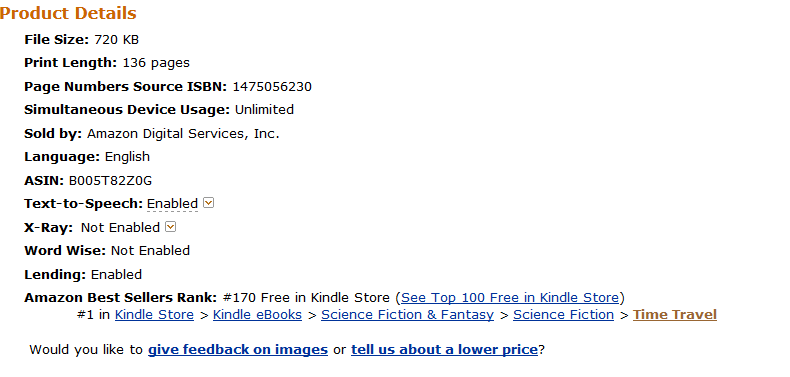 Lyon's Legacy has made Top Ten in the Time Travel category on Amazon a few times, mostly when I put it on sale and advertised it on Book Gorilla. The first weekend it was permafree it also moved a lot of units without paid ads and reached #170 on Amazon overall for free books. Granted, each time there were only a few hundred units involved, and of
course after a few days the novella slipped down the charts again. Other
works of mine, such as "Letters to Psyche," Life at Seventeen Syllables a Day, and even SF Women A-Z also made it into the best-seller list for more obscure categories briefly with only a couple of sales. So, yes, I will grant this author the fact that Amazon bestseller status for an hour or two for a subcategory does not necessarily match numbers with bookstore sales generated over a week.
Is Amazon bestseller status misleading or meaningless, though? The author who complained about this is a well-known, award-winning author who shouldn't feel threatened by indie authors like me, who only make a handful of sales each month. For me, it is exciting to see a book climb the charts, even if I know it won't last. (However, when overall sales are slow, Lyon's Legacy can still linger for a while on the free Time Travel bestseller list with few sales, albeit near the bottom.) I do list Lyon's Legacy Top Ten Time Travel bestseller status in its book description on Amazon since I think that is a significant accomplishment. Maybe it came about after an ad, but then publishers pay bookstores for prominent placement of featured books, so they also invest in that status.
As for other bestseller lists, they can be gamed by people who know which bookstores are counted when compiling those lists, and the list-makers have been known to manipulate the lists to keep eBooks and the Harry Potter series off of the lists. Barnes and Noble has been accused of deliberately suppressing the ranks of indie books in certain genres so they don't compete with traditionally published books. Amazon can be gamed too, but in my opinion, it is the most honest, transparent store when it comes to its bestseller lists.
Bestseller status is important to big publishers and their authors, since they profit most when they sell lots of copies of a single title in a short time. Indie authors with lower overheads can make money off of fewer sales sustained over a long period of time. While it looks nice to be a bestseller, in the long run, I would like to have sustainable sales supported by true fans and word-of-mouth. It may take a lot of sales to many different people to reach my target audience, however. I will only mention bestseller status for my works in the book description if it makes it to the Top Ten of its category. And while it's hard to avoid comparing yourself with others, for my own career, I'd rather focus on writing and publishing the best books that I can. As a reader, I'm too independent to read something just because it's a bestseller, but I realize others might value that popularity.
How do you feel about bestseller status for books? Does it matter to you as a reader? Do you care how the bestseller status was earned?
Monday, July 27, 2015
How Much Character Pain Can You Read About?
I started reading Jo Walton's All My Children last week, but after I started it, I put it aside for a couple of days. There was a section that I didn't want to read because the protagonist was trapped in a miserable marriage. Fortunately, once I got past that section, her life improved. Still, it got me thinking that while we as writers are supposed to make life tough for our characters, it's possible to put them in so much emotional pain that it becomes uncomfortable for the reader. Two writers who really inconvenience their characters are Jim Butcher and Laura Resnick. It's not enough that their characters have to fight some bad guys, but oftentimes they have to do it while being up all night, dressed in something inappropriate, and needing to use the bathroom, all at once. Sometimes I find the trivial issues (like the wrong outfit) distracting from the major conflict. As a mother, I don't like reading about kids in jeopardy either.
Are there types of conflict or emotional pain that you don't care to read about? Feel free to discuss them in the comments section--if you don't mind doing so, that is.
Are there types of conflict or emotional pain that you don't care to read about? Feel free to discuss them in the comments section--if you don't mind doing so, that is.
Friday, July 24, 2015
Science of the Week, 7/24/15
Here are the most interesting science news articles I read this week:
Here's everything we know about the most Earth-like exoplanet ever found
Futuristic brain probe allows for wireless control of neurons
Adolescent friendship study confirms "birds of a feather flock together--stay together"
Scientists reveal "woodquakes"
Bringing back the magic in metamaterials
Metal foams capable of shielding X-rays, gamma rays, neutron radiation
Centuries-old shipwreck discovered off NC Coast
Long-sought phenomenon "Weyl points" finally detected
14,000-year-old tooth shows oldest form of dentristy and it's pretty grim
Skeleton of Alexander the Great's father found
Sweet revenge against superbugs
New mussel-inspired surgical protein glue: close wounds, open medical possibilities
Gut worms protect babies' brains from inflammation
(but I still wouldn't want to give them to my child)
How nanoparticles can clean up environmental pollutants
Have a good weekend, and see you Monday!
Wednesday, July 22, 2015
Popcorn Ideas
While I give the first draft of Chaos Season a chance to breathe (or my brain a break from it), I'm working on two shorter works. Or at least I'm trying to. I have been working on "The Unnumbered World," the next story in the Catalyst Chronicles universe, but I haven't done much with Young Seasons, a short story collection featuring the heroines of the Season Avatars series. However, I have already drafted the first chapter of Fifth Season, the next Season Avatars book. But I'm also getting ideas for a holiday Season Avatars story (I'm still not sure where it would fall in the series), an old short story I never finished, and new short stories. (Don't ask me where all these ideas are coming from. Maybe it has to do with my chronic sleep deficit, or maybe my mind is secretly trying to distract me so I don't finish a single story.) All this, especially combined with the rest of my Real Life To-Do List, makes my brain feel like this:
(Thanks to Kristine Katherine Rusch for introducing me to popcorn kittens on her blog.)
I guess I need to jot these ideas down, review my project list and decide what priority they should be. I also need to learn to write faster so I can complete more stories and get them out of my head.
What makes your brain feel like popcorn kittens are bouncing around your skull?
Monday, July 20, 2015
Ingredients for a Great Series
Lois McMaster Bujold was one of the many authors I featured during my April A-Z Women in SF Challenge. At that time, I wasn't very far along in her Vorkosigan Saga. I've been working on it and now have only one more book to read before I'm caught up. Going into this reading project, I wouldn't have expected I'd enjoy this series so much. Here are a few things about this series that IMO make it compelling:
It spans genres: This series is a mix of everything: military SF, mystery, romance, and more.
Its setting: This saga is set in a universe where many different planets have been colonized. Each planet has a different culture, which allows for not only interesting world-building but also conflict.
Its characters and their challenges: Most of these stories feature Miles Vorkosigan, who suffers a variety of physical challenges (for those of you who haven't read the series yet, I won't detail his issues or how he acquires them). However, his problems have led him to develop great ingenuity and persistence. There is, of course, ample evidence in the early books that he may have inherited those traits. Although Miles may be dominant, he's not the only noteworthy character in this series. There are important secondary characters who get turns being the point-of-view character, and there are several quite memorable minor characters who help flesh out the books.
Going along with the characters themselves are their character arcs. The events in this series span decades. Characters go in and out of different careers and relationships and learn from their mistakes. This education can be hard-won at times, and the characters suffer, but it helps make readers care about these characters too.
Humor: Along with all the action and intrigue are touches of humor. I think the book with the best humor so far is A Civil Campaign.
The interrelatedness of the books: Each book can work as a stand-alone, but as many early locations and characters reappear, there are a lot of references to earlier events, especially in the later books. I remembered a lot of the references since I read the books so close together, but there are a few times where I did lose track. However, it was nice to be able to reconnect with earlier characters. The chronological order of the stories (not all of them are full-length novels) isn't the same as the publication date, so it's wise to read the series in chronological order if you're not familiar with it.
Have you read the Vorkosigan series, or any other works by Bujold? If so, what did you think of them? Feel free to share your opinions in the comments.
Friday, July 17, 2015
Science of the Week, 7/17/15
Here are some of the most interesting science news articles I read this week:
New particle discovered at the Large Hadron Collider
Can you actually hear "inaudible" sound?
Neuroscience and technology come together to support people with disabilities
Where does water go when it doesn't flow?
The quantum physics of artificial light harvesting
Intellectual pursuits may buffer the brain against addiction
Like sitting, standing in the workplace may have long-term health consequences
Large feathered, winged dinosaur was close relative of velociraptor
Human-wrought environmental changes impacting crops and pollinators could harm health of millions
Autonomous taxis would deliver significant environmental and economic benefits
Gut microbes enable coffee pest to withstand extremely toxic concentrations of caffeine
The sleep-deprived brain can mistake friends for foes
(Better be careful around me--I never get enough sleep!)
Have a good weekend, and I'll see you Monday!
Subscribe to:
Posts (Atom)