With June almost over, it's time for my semiannual reading report. My reading goal for this year is 200 books, and I'm at the halfway point with 100 books. (ETA: You can follow along with my 2015 reading challenge on Goodreads.) These numbers include everything from individual short stories listed on Goodreads to omnibus editions. I did include a couple of books I read over and over with my son, but most of them I generally don't track. (I also didn't track some of the Hugo nominees I've read.) I typically save my genre and format breakdown for the end of the year, but this time I decided to go ahead and do it. First is the genre breakdown:
Fantasy: 35
Science Fiction: 25
Other Fiction: 9
Non-Fiction: 31
Here's the split between eBook and paper formats:
eBook: 72
Paper: 28
Most of the paper books I read are from the library. If the eBook I want to read is priced above what I think is reasonable, I may get the paper version instead. (This is what I did for Prudence and Bujold's series.)
Diversity reads (I try to read at least one book a month by someone of a different sexuality or racial/ethnic background) so far include Sere from the Green, The Summer Prince, The Three-Body Problem, and The New Moon's Arms.
Finally, here are some of my favorite reads so far for the year:
We, the People of the Clouds
Miles, Mystery, and Mayhem
Company Daughter
Winter Queen
Big Dragons Don't Cry
Cordelia's Honor
Centaur of the Crime
The Mermaid's Sister
Her Instruments trilogy
What books have you enjoyed so far this year?

Monday, June 29, 2015


Friday, June 26, 2015
Science of the Week, 6/26/15
Here are some of the most interesting science news articles I read this week:
Newly discovered "ring of teeth" helps determine what common ancestor of moulting animals looked like (this is Halluigenia from the Cambrian)
NIH begins clinical trial of new medication for alcohol use disorder
Using directed energy propulsion for interstellar travel
Medication may stop drug and alcohol addiction
Inflaming the drive for suicide
Disabled people pilot a robot remotely with their thoughts
Island rodents take on nightmarish proportions
(I wonder if this explains the ROUS in The Princess Bride)
Heartbeat on a chip could improve pharmaceutical tests
Have a good weekend, and I'll see you Monday!
Hallucigenia
Hallucigenia
Wednesday, June 24, 2015
Dean Wesley Smith: The Real Price of Traditional Publishing
In the interest of freeing up some blogging time for writing, I'm going to link to a very important post Dean Wesley Smith made about the real price of traditional publishing. With upfront advances and the prestige of working with a publisher, traditional publishing still holds appeal for some authors. But is it worth it, especially with advances for genre works shrinking and right grabs for life plus seventy years? What income might a first-time author expect to see from one traditionally published book over thirty-five years, and how many books would an indie author need to sell to reach that income every year? The answer may surprise you. Of course, best-selling authors may have better deals than the one Smith describes, but if you don't have that clout, make sure you read whatever contract you sign carefully.
And now back to Chaos Season for me. I may not finish the first draft by June 30th, but I should be close. Hopefully I can finish by mid-July at the absolute latest.
And now back to Chaos Season for me. I may not finish the first draft by June 30th, but I should be close. Hopefully I can finish by mid-July at the absolute latest.
Monday, June 22, 2015
WIP Excerpt: Chaos Season--Jenna's Tree
Yesterday was the summer solstice. In my fantasy world of the Season Avatars, solstices and equinoxes are important in the country of Challen. The Season Avatars are all born on the first day of their seasons--in fact, no one else in the country is ever born on a solstice or equinox. The Summer Avatars have plant magic and bond with a tree to help them use this magic. Here's a scene from my current work in progress called Chaos Season. This book is told from the point of view of Jenna Dorshay t'Reve, the current Summer Avatar. Here's part of the scene where she sprouts her oak tree.
The embryo inside her chosen acorn cried out for joy as it sucked in its first drops of water. Having already missed the best sprouting time, it was eager to grow. Jenna needed to force-grow it past the most vulnerable stages.
She put her hands on the mud, reaching for the sprout and encouraging it upward, toward the sun, and downward to create a strong root network. A green tip burst through the soil. Jenna directed nourishment at it. She grinned as it became a twig, then shot out its first true leaves.
“Back off on the rain a bit, Kay,” she said. “My tree needs sun too.”
The leaves worked frantically to make its own nutrients. Although the tree grew much faster than it normally would, Jenna longed to see it reach its full potential. She laid a finger on the still-delicate sapling, watching it lay down rings of growth around its trunk. Soon it was as high as her waist and as thick as her thumb. But that wasn’t enough. The tree grew taller and wider. When it was as tall as her, branches split apart from the top. Now she could press both hands on it, urging it to keep going. It obliged. She stared at its most intimate parts, mesmerized by the dance of life going on at levels no one else could see…
I hope you enjoyed that and had a great solstice!
Friday, June 19, 2015
Science of the Week, 6/19/15
Here are some of the most interesting science news articles I read this week:
Low birth rates can actually pay off in the U.S. and other countries
Asian, European languages not so different under the hood
Re-examining the "first impressions" adage
(This article is especially interesting for writers because it discusses what kinds of information make people reverse their initial impressions of fictional characters.)
A dearth of nutrition in school lunches
Origami robot climbs inclines, swims, and carries loads twice its weight
Interventions among healthy people save the most lives
New type of drug can target all disease-causing proteins
FDA approves brain implant to help reduce Parkinson's, essential tremor symptoms
Arctic Ocean rapidly becoming more corrosive to marine species
What's on the surface of a black hole?
(Potential source of SF story ideas here.)
Researchers discover first sensor of Earth's magnetic field in an animal
Do social insects share brain power?
Viewing cat videos boosts energy and positive emotions
(So there is reason to post cat videos on Facebook!)
Wednesday, June 17, 2015
Selecting KDP Select or Not?
A couple of days ago, Amazon announced a major change to how authors in the Kindle Unlimited program would be compensated. When KU was formed last year, authors were paid if a reader read past 10% of the book length. This led to a lot of authors putting short stories and serials into the program. To encourage authors to add longer books, Amazon will start paying them next month by the number of pages read.
Currently, I only have one short story, "Letters to Psyche," in Select. I prefer to put my work in wide distribution, both to benefit readers and to make sure each book has the potential to give me multiple income streams. That said, most of my sales do come from Amazon. I get a few by distributing through Draft to Digital, even less via Smashwords, and so far none through Google Play. I have put some of my work in Select for brief periods of time. For example, Seasons' Beginnings was in Select for the first three months before I put it in wide distribution. I got a few borrows, but it wasn't hugely popular. However, I put Scattered Seasons in wide distribution from the start because the first book was available everywhere. Since there is a big shift in the Season Avatars series between books One and Two, I plan to write a short story collection featuring the characters from Scattered Seasons and use that as a way to introduce readers to the series. The question now is whether I should make the collection perrmafree everywhere or put it in KU first and see how it works. I face the same decision with "The Unnumbered World," the next story in the Catalyst Chronicles series. All novels from both series will be in wide distribution, but at some point, I may write another series and keep it exclusive to Amazon.
What do you think of the KU Program? Are you signed up for it as a reader or writer? Please let me know in the comments.
Monday, June 15, 2015
New Women in Science Fiction Project
Remember my SF Women A-Z series back in April? Well, apparently I'm not the only one with a project to promote women SF authors. Writer/editor Kristine Kathryn Rusch is working with Baen Books to create an anthology (in several volumes) of short fiction by classic SF women authors. You can read more about her project here and suggest authors/works on the associated website. For more background about why this project is necessary, check out Rusch's latest Business Musings, in which she describes how publishing's need for bestsellers led to rapid churn of the books carried by bookstores. This in turn means bookstores are less likely to carry backlisted titles. Even libraries end up culling unpopular books from their shelves to make room for new ones. We're fortunate that these days classic stories can be made immortal in digital format so they're not forgotten.
Are there any classic but "forgotten" SF stories that you think should be read by contemporary readers? If so, please list them in the comments.
Are there any classic but "forgotten" SF stories that you think should be read by contemporary readers? If so, please list them in the comments.
Friday, June 12, 2015
Science of the Week, 6/12/15
Here are some of the most interesting science news stories I read this week:
Foreign language learning in adults associated with genetic variation
DNA breakage underlies both learning, age-related damage
(I hope that doesn't mean people who learn a lot age faster)
Researchers design the most precise quantum thermometer to date
Falling apart: over 95% of the world's population has health problems
Robots from South Korea, US win DARPA finals
Mission possible: This device will self-destruct when heated
Soft robotic glove could [help] loss of hand motor control from muscular dystrophy, ALS, or spinal cord injury
Crop adjustments may lessen climate change's economic effects
Scientists show fMRI memory detectors can be easily fooled
Scientists may have found red blood cells in 75-million-year old dinosaur fossil
Engineers develop a computer that operates on water droplets
Plan to convert U.S. to 100% clean, renewable energy by 2050
Man's best germs: does your dog influence your health?
Chimps may know when they are right and move to prove it
Could an Ebola treatment already exist?
MIT team creates ultracold molecules
Nuts and peanuts may protect against major causes of death
Have a good weekend, and see you Monday!
Wednesday, June 10, 2015
Reading the Hugo-Nominated Novels
I'm a supporting member of this year's Worldcon. My main reason for registering, of course, is to vote for the Hugos. So far I've read four of the five novels, three of the novellas, and two of the novelettes (I'm currently working on a third.) Here are some of my thoughts on the novels. I'll try to avoid spoilers, but it may be hard to discuss some points without details--or the politics behind the choices.
The Three-Body Problem--This is an English translation of a Chinese novel (so it counted for my Diversity Read last month). It starts during the Chinese Cultural Revolution and goes up to the present day, though the story line skips around a bit. A young woman scientist gets caught up in political affairs and ends up working on a top-secret project to contact aliens. Embittered by her father's death, the woman invites aliens from an imperiled planet to invade Earth. The aliens use a variety of scientific and psychological tricks to prevent Earth from mounting a resistance. This is the first book of a trilogy, so the outcome isn't decided in this book. I found the characters flat at first and found this book initially difficult to get into. Once the Three-Body Problem game was introduced, it picked up. Still, some subplots of the story felt like they got dropped after that point (maybe they'll be picked up in the next books), and to me, while some of the aliens' plans pose interesting questions about the nature of science, they also seem like some over-the-top plan from a James Bond movie to kill the agent (i.e., too complicated when a simple plan would be more effective). The science part overshadows the fiction to me.
The Goblin Emperor--The half-breed fourth son of the elven emperor succeeds to the throne when his father and older brothers are all killed at once. He was never expected to become emperor, was disliked by his father, and sent away to a remote area without proper training for his role. As soon as he learns the news, he proceeds to the capital to take the crown before he can be killed or manipulated. However, he has a lot to learn about how his court works, and his temperament is much different from his father's. This is a slow-paced book with lots of characters that are hard to keep straight. I still enjoyed seeing the title character grow into his role.
Ancillary Sword--The sequel to Ancillary Justice,which I read last year. This story continues to use female pronouns and quick POV shifts within scenes as in the first book. (The main character used to be the brains of a spaceship, able to sense everything through its ancillary crew, but is now confined to a single human body.) The main character is now commander of her own ship and takes on a mission to another planet on behalf of the Lord of the Radch. An interesting story, but I'm not sure how it's advancing the overall plot of the trilogy.
The Darkness Between the Stars--Although this is the first book of a series, it's set after another seven-book series which I haven't read. Apparently it features a lot of characters and families from the previous series. There's a lot of backstory which slows things down, and again there are so many characters it's hard to keep track of them all. Chapters are short and mention the name of the POV character, which helps a lot. Still, in an epic story like this, some storylines and characters get more space than others. (Some of them don't seem necessary to me, but they may have been more important in the first series.) The story is set about twenty years after a major war in space and shows new hostilities rising up again. Some of the aliens, such as the world trees, seem to be a SF counterpart to the traditional fantasy elements of earth, air, fire, and water. (I see at least three elements in the book, but I'm not sure how air is represented.) Characters can be a bit one-note and stereotypical at times.
Skin Game--Part of the Dresden Files series. I've read some of the series, but I'm not up-to-date on it. This makes me reluctant to read this work (the voting packet does not feature the complete book) for fear of spoiling the books I haven't read yet. Still, I'm trying to give all the nominees a fair read (I admit I'm not objective--that's why I registered to vote in the first place), so I may have to borrow it from the library if available.
Have you read any of these books? If so, what did you think of them?
Monday, June 08, 2015
Facts for Fiction: The Next Species
It's hard enough contemplating one's own mortality, let alone that of the species to which we belong. However, in The Next Species: The Future of Evolution in the Aftermath of Man, Michael Tennesen does just that. After all, we are the only species that keeps a Doomsday Clock, and the hands are only three minutes shy of midnight.
Tennesen starts by looking at previous mass extinctions to examine what caused them. The most famous mass extinction was that of the dinosaurs, which was caused when an asteroid collided with the Earth and raised a giant dust cloud that blocked the sun. However, climate change, such as global warming or cooling, also contributes to extinction, and there are several warning signs already present. Tennesen speculates on our end--and that of other species. However, every end is also a beginning. Quick-growing, "weedy" species often move in to take advantage of cleared niches, but they are gradually replaced by bigger, more specialized species. In time, big animals may return.
Is there no hope for humans? Well, there is the possibility of establishing a colony on Mars as a backup for Earth. Human evolution isn't dead; even if a catastrophe wipes out the vast majority of us, the rest could repopulate and perhaps establish a successor species to Homo sapiens. (There is evidence our species did pass through a genetic bottleneck at one point.) Of course, details about what such a species might look like are best left to the science fiction writers.
Do you think our species is as close to destruction as the Doomsday Clock says, or is there still hope for us and our children? Feel free to discuss in the comments.
Thursday, June 04, 2015
Science of the Week, 6/5/15
Here are some of the most interesting science news articles I read this week:
Experiment confirms quantum theory weirdness: Reality doesn't exist until measured
A patient's budding cortex--in a dish?
Researchers grow mouse limb in a lab--could work for primates
Cheetah learns to jump
Researchers find textbook-altering link between brain, immune system
(Believe it or not, I read about this first through Facebook links before I had time to read in on Science Blog.)
Chimpanzees have congitive capacity for cooking
Bacteria may cause Type 2 diabetes
Most Americans can eat locally, research shows
A world without color--researchers find gene mutation that strips color, reduces vision
Invasive microbe protects corals from global warming, but at a cost
Even when we're resting, our brains are preparing us to be social
Researchers find "lost" memories
Have a good weekend, and see you Monday!
Wednesday, June 03, 2015
IWSG: Realistic Goals
It's time once again for another edition of the Insecure Writers' Support Group, which is held the first Wednesday of every month. You can learn more about IWSG here.
This month, I've set a goal for myself of finishing the first draft of Chaos Season. I'm at about 50,000 words, and the last two books have been between 75,000-80,000 words, so it's not an unreasonable goal if I can manage at least 1,000 words a day. The question is, how manageable is that, given all of the other things I have to do? Of course I work full-time, and afterwards I have to take care of family chores in the evening. While I don't have to worry about SF Women A-Z, WisCon, or my son's birthday anymore, I still have other side projects too. I'd like to finish redecorating and setting up Alex's playroom this month, along with decluttering some other areas of the house. (Just getting all of the Legos into the playroom would be a major cleanup!) As Readings/Events Coordinator for Broad Universe, I have a couple of spreadsheets and forms to prepare so I can stay on top of my duties. Plus there are a few things left over from May, but they're not big tasks. So my writing time will be squeezed, but with a half hour of writing on my lunch hour, and some time writing at night, I should be able to make 1,000 words a day as long as I know what to write. I have a general sense of what happens next in the story and the climax, though there may be some side plots I have to resolve before I get to the climax. I don't have an outline for this story; the first draft is basically my outline. I'll need to do at least one thorough edit before this story is ready for betas.
Given everything I've just said, while I would be happy to finish Chaos Season by June 30th, I'm not going to beat myself up if I'm off by a few days. I haven't set a release date for this book yet, so I can be flexible if necessary. Writing quickly is a valuable asset for an indie, but it's also important to make sure the final book is as good as I can make it at this time.
Do you set goals and deadlines for your own work? Are they external or self-imposed? How much do they stress you out? Feel free to share in the comments.
Monday, June 01, 2015
Two Giveaways for Scattered Seasons

If you're not in the U.S., or if you prefer e-books, you can request an e-book copy for review through LibraryThing. I don't have an exact link for this giveaway, so you have to scroll down this list. I'm willing to give away up to 100 e-books in PDF, EPUB, or MOBI formats, and this giveaway will run through June 15th.
Good luck to all!
Friday, May 29, 2015
Science of the Week, 5/29/15
Here are some of the most interesting science news articles I read this week:
A new human ancestor has been discovered in Ethiopia
New class of baked, expanding magnets has potential to energize the world
An egg a day may keep the doctor away
Nearly indestructible virus yields tool to treat diseases
Researchers tie unexpected brain structures to creativity--and to stifling it
Natural enzyme lysozyme examined as antibiotics alternative
Spinning a new version of silk
Diagnosing cancer with help from bacteria
Do you have any plans for the weekend? My son turns eight tomorrow, so there will be a birthday party and lots of Legos in his future. Hope you have fun too!
Wednesday, May 27, 2015
WisCon 39 WriteUp
It still doesn't seem like a Wednesday to me. How about you?
My first WisCon was in 1998. Since I missed 2007, I've been to seventeen WisCons. That's nearly two months of my life that I've spent going to this convention! Over the years, there have been a lot of changes to the convention, the city, and my writing career. That said, WisCon is still one of the highlights of my year.
Most of Friday was spent packing and taking care of last-minute details as I waited for school to let out. We picked Alex up and drove straight to Madison, arriving around 5:00. As I picked up badges and dropped off my books at the Broad Universe table, I saw friends of ours, then ran into another couple we knew as we headed out for dinner. We wound up having dinner and gelato with both couples and missed the opening ceremonies. I enjoyed the evening, but it was a little bittersweet in that one of the couples was moving out of state and had come to the convention to see us. I hope we get to visit either here or in New York, Dave and Judy! I did go to a panel (Overlapping Magestria--basically about science and religion) after we got back, but I was too tired for the parties.
Saturday morning we visited the farmer's market, then I attended an interesting panel on gender, sex, and science. For lunch, I joined three members of Broad Universe. The weather was gorgeous, and we spent a little more time at the farmer's market while we waited for our table. We returned to the hotel halfway through the first panel, so I skipped it and visited the dealer's room and the art show. Mid-afternoon was the Broad Universe Rapid-Fire Reading; I both moderated and read from Scattered Seasons.I spent an hour at the Broad Universe table before going out for Japanese with my family and "the boys."

Oscar and Little Penguin: SUSHI!
Stan: Sushi?
Rex: Who's she, and why are you suing her?
Saturday night was like Friday in that I skipped the main attraction of the evening (the Tiptree auction), attended another panel on science-compatible religion, and then went to bed. What a wild life I lead.
On Sunday, I attended a few more panels throughout the day, including ethical non-mongamy in fiction, what makes a character come alive, and illness tropes. I particularly found the last one useful.I worked a couple more hours at the Broad Universe table and helped back up all the supplies at the end of the day. (Since I'm the Readings/Events Coordinator for Broad Universe, I will be sending the supplies to other conventions.) We did actually get back from dinner in time for the Guest of Honor speeches, but instead I helped set up the Broad Universe party and stayed there until 11:40 or so. That's about as much as a sleep-deprived person like me can manage.
Monday morning we met some college friends for breakfast, then checked out of the hotel. I finished up some last-minute Broad Universe business before attending the SignOut. I did have a few familiar faces to keep me company and help with the display.
 I didn't sell a lot of paper books during the convention, but I did notice a slight upswing in eBook sales. I also put on my publisher's hat and approached a couple of the indie bookstore representatives in the dealer's room about stocking my titles. (I'm setting up my books on IngramSpark in addition to CreateSpace, and IngramSpark offers better terms for booksellers.) We'll see if anything comes from that. I did actually buy three paper books from the dealers, as that seemed only fair.
This was also the first time Alex was old enough for kid's programming. He wasn't in it full-time, since he didn't want to do all of the activities. But the kid's track may make it possible for me to attend some of the local cons as well.
It was an intense weekend, but I got to see old friends and meet other people that I've only known online, visit my favorite city during the best part of the year, and immerse myself in books and SF for a while. I wish WisCon was longer, but it would be tough on my wallet.
Do you ever go to conventions? If so, which ones?
Monday, May 25, 2015
Children's Crusade
I'll have a full report on WisCon on Wednesday, in the meantime. to remember Memorial Day, here's Sting's "Children's Crusade":
Wednesday, May 20, 2015
Science of the Week, 5/22/15
(This obviously wasn't supposed to be posted until Friday. I originally had it scheduled then, but the setting must have changed during editing. Apologies for that.)
Happy Memorial Day weekend to those of you who celebrate it! I'll be at WisCon in Madison, Wisconsin this weekend. I'll be reading from Scattered Seasons Saturday afternoon along with other members of Broad Universe in a rapid-fire reading, and I'll be participating in the Sign Out Monday morning. Along the way I'll help out at the Broad Universe table and party, see friends, and attend panels. There will be a more detailed report next week.
In the meantime, here are some of the most interest science news articles I read this week:
A proven approach to helping the ultra-poor
Translating thought to print with spider silk
How microbes acquire electricity in making methane
Personal microbiomes shown to contain unique "fingerprints"
Nano memory cell can mimic the brain's long-term memory
Photonic computing at the speed of light
Take Off Your Pants!
The title doesn't refer to clothing, but to a writing method of working without a plan, more commonly known as "pantsing," for writing by the seat of your pants. I tend to write like this myself, but this often means it takes several drafts for me to come up with a workable plot. That said, I've tried outlining before but haven't been very effective with it. Writing projects more quickly and with fewer drafts would allow me to increase my output (which is important for indie authors who want to earn a living) and take care of all the projects I have in mind but don't have the time for. So I thought I'd read Take Off Your Pants! Outline Your Books for Faster, Better Writing by Libbie Hawker. She says in the beginning of this book she was able to write a complete book in three weeks with this method. I don't think I could manage that with a day job and a school-age son, but I'd like not to take months or even years either.
In my previous attempts at outlining, I always started at the beginning of the book and listed the main events of the plot in order. Hawker takes a different approach by first focusing on the emotional journey of the main character. According to her, the point of the story is the main character's personal growth as she learns to overcome a flaw. So, with Hawker's approach, you would first develop the main character, the weakness she must face, and the external goal that will force her to grow. From there, you would develop other characters, the theme, and a couple other aspects of the story. Finally, you would come up with the events of the story, using the Hero's Journey as a template. Another key part of plotting is pacing, and Hawker describes a technique to keep readers hooked.
There are a few things about Hawker's method that I didn't agree with. Some stories and genres don't seem to focus on character growth. For example, the detective in a mystery series, like Sherlock Holmes or Miss Marple, doesn't develop much, if at all, over the story. This type of story focuses in ideas, not characters. Also, Hawker states that an antagonist typically wants the same goal as the protagonist, as if they're competing for a prize. I don't think that's always the case. Nonetheless, she's more experienced at outlining than I certainly am. Even though I'm already halfway through Chaos Season, I'm going to try this method to develop the second half of the novel and plan the parts in the first section that need changing. At the same time, I'll also work on outlines for the final two books in the series, Fifth Season and Summon the Seasons. This will be tricky, as a different Avatar is the main character of each book, yet some characters will continue to develop after "their" book is over. Good thing Hawker's method can be used for books with multiple main characters too.
For the writers out there, do you plot or pants? If you plot, what do you think of Hawker's method? Readers, do you feel character growth is always more important than action? Why or why not?
Monday, May 18, 2015
Three Stuffed Animals Visit the Field Museum
If you're friends with me on Facebook, you may already be familiar with Stan, Rex, and Oscar, three stuffed animals we bring with us on trips, photograph in unusual locations, and give funny lines. Oscar, the orca, is the oldest; we got him on our honeymoon when we started this tradition. Stan (the green T-rex) and Rex (the brachiosaurus) were adopted from the Field Museum for Alex. The three stuffed animals got to come with us to Members' Night at the Field Museum, and they had a blast (or should I say we had a blast with them.) Here are a few highlights:
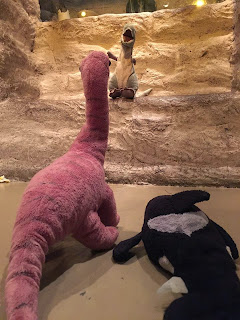 Stan: "I am Stan, the God of carnivores! Hear me roar."
Rex: "Should we bow?"
Oscar: "Are you kidding? He's got a big enough head as it is!"


Stan: "What? How could it go on without us?"
Rex: "It probably wasn't as fun."
Oscar: "Yes, I am a prime example!"
 Stan: "NOT funny!"
Rex: "Not funny at all!"

 Stan: Murderers!
Rex: Wrong meteorites, Stan.
Stan: Recognize anyone?
Rex: Nope.
 Stan "Hey! This wasn't on the agenda today!"
Oscar & Rex (laughter off screen)

Rex: "Should we bow?"
Oscar: "Are you kidding? He's got a big enough head as it is!"


Stan: "What? How could it go on without us?"
Rex: "It probably wasn't as fun."
Oscar: "Yes, I am a prime example!"
 Stan: "NOT funny!"
Rex: "Not funny at all!"
 Stan: Murderers!
Rex: Wrong meteorites, Stan.
Stan: Recognize anyone?
Rex: Nope.
Oscar & Rex (laughter off screen)

Friday, May 15, 2015
Science of the Week, 5/15/15
It's hard to believe it's already mid-May, isn't it?
Here are a few science news articles that caught my attention this week:
Partnership for finding particles
Chemistry student in sun harvest breakthrough?
Measles may weaken immune system up to three years
Familarity breeds empathy
Research paper with 2,683 authors expands knowledge of bacteriophages
Tapping the potential of undergraduate researchers
An important step in artificial intelligence
Male hormones help female lemurs rule
Rats will try to save members of their own species from drowning
Real astrology: birth month really does affect personality
(I wish they had more information about this so I could see how well my Season Avatars match up to this.)
More bees dying each year
Have a good weekend, and I'll see you Monday!
Subscribe to:
Posts (Atom)